Expertenanalyse zu Camille Pissarros Near Pointoise
Stil: Impressionism · Genre: landscape
Expert Analysis of "Near Pointoise" by Camille Pissarro
As an Impressionist landscape, Near Pointoise exemplifies the radical shift in artistic priorities that defined the movement in the late 19th century. Camille Pissarro, often called the "dean" of the Impressionists, brought a distinctive sensitivity to this work that underscores its significance.
Stylistic Significance:
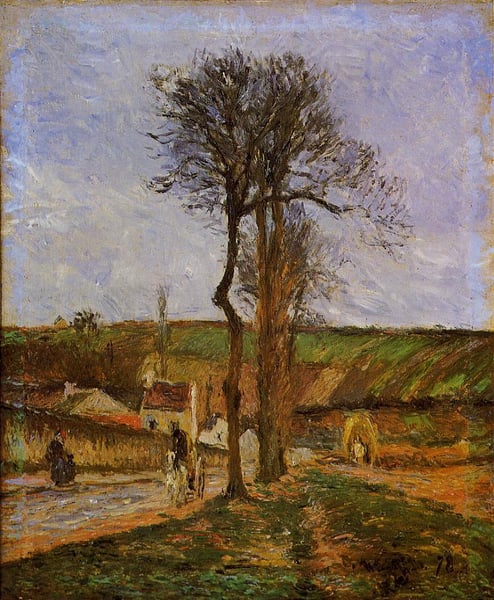
Pissarro’s handling of landscape rejects the polished, idealized scenes of academic painting. Instead, he embraces the hallmarks of Impressionism: visible, broken brushstrokes, a brightened palette, and an emphasis on capturing the transient effects of light and atmosphere. The title’s reference to Pontoise—a rural village northwest of Paris where Pissarro lived and worked—reflects the Impressionist commitment to painting en plein air and depicting modern, everyday life rather than historical or mythological subjects.
Subject and Composition:
The landscape genre is elevated here from mere backdrop to the central subject. Pissarro likely focuses on a humble rural vista—fields, trees, and perhaps a path or buildings—without dramatic narrative. This ordinariness is precisely the point: Impressionists sought to show the beauty in the fleeting, unremarkable moments of the natural world. The work’s significance lies in its ability to transform a simple view “near Pontoise” into a study of light filtering through foliage, the vibration of color on a sunny day, and the texture of earth and sky.
Contribution to Impressionism:
Pissarro’s version of landscape was particularly influential because he balanced spontaneity with structural clarity. Unlike some of his contemporaries who dissolved form entirely, Pissarro retained a sense of solidity in trees, houses, and fields while still suggesting the shimmer of the atmosphere. Near Pointoise thus demonstrates how Impressionism could be both revolutionary and accessible—it invites the viewer to experience a moment of natural harmony, recorded with direct, unmediated vision.
In summary, this artwork is significant as a pure specimen of Impressionist landscape painting, showcasing Pissarro’s mastery of light, color, and everyday rural scenery that helped define the movement’s break from tradition.
Museum / Gallery
Visuell ähnlich
20 Werke mit ähnlicher Komposition und Farbpalette
Pontoise, Les Mathurins
Camille Pissarro
Strong Winds, Pontoise
Camille Pissarro
Street in Rouen
Paul Gauguin
Road to Louveciennes
Camille Pissarro
The Road to Saint Cyr at Louveciennes
Camille Pissarro
Route du Fond in Hermitage, Pontoise
Camille Pissarro
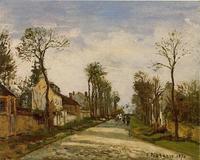
The Road to Versailles at Louveciennes
Camille Pissarro
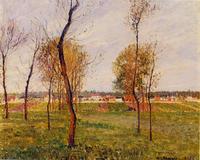
A Meadow in Moret
Camille Pissarro
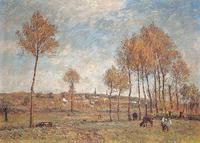
At Montreuil, France
James Charles
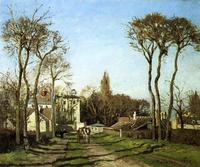
Entrance to the Village of Voisins, Yvelines
Camille Pissarro
Gennevilliers Plain
Claude Monet
The First Hoarfrost
Alfred Sisley
Street Winter Sunlight and Snow
Camille Pissarro
The Seine at Marly
Alfred Sisley
Thaw, Pontoise
Camille Pissarro
The Louveciennes Road
Camille Pissarro
Snow Effect, The Road to Louveciennes
Claude Monet
Quay at Dieppe
Gustave Loiseau
Stagecoach to Louveciennes
Camille Pissarro
Landscape with a Man Digging
Camille Pissarro