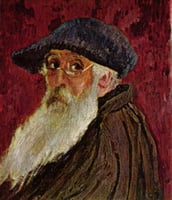
Expert analysis of Camille Pissarro’s Old Winegrower in Moret
Style: Impressionism · Genre: portrait
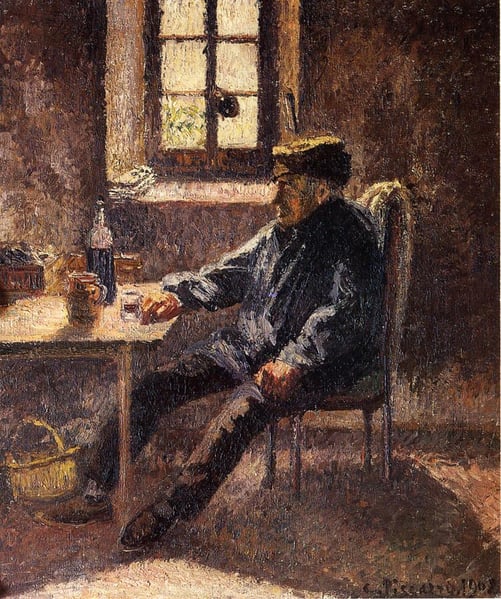
Camille Pissarro's Old Winegrower in Moret stands as a compelling example of how Impressionist portraiture diverged from academic traditions by celebrating the dignity of everyday rural labor. Painted in the village of Moret-sur-Loing, the work reflects Pissarro’s lifelong commitment to depicting peasant life with honest, unidealized warmth.
As an Impressionist portrait, the painting’s significance lies in its rejection of formal studio conventions. Instead of a posed noble or bourgeois sitter, Pissarro elevates an anonymous worker—a winegrower—to the status of a worthy subject. The artist’s hallmark broken brushwork and sensitivity to natural light infuse the figure with a sense of vitality and immediacy, capturing not just a likeness but the transient effects of atmosphere on skin and clothing. The muted, earthy palette (ochres, greens, soft grays) harmonizes with the rural environment, anchoring the sitter within his landscape rather than isolating him against a dark background.
This portrait is also significant for its subtle psychological depth. The winegrower’s weathered face and steady gaze convey a life of hard-won knowledge and quiet resilience—a far cry from the idealized or sentimentalized peasants of earlier academic painting. Pissarro’s socialist sympathies are evident here: the work affirms the value and humanity of the working class, a core tenet of his artistic philosophy. In the broader context of Impressionism, Old Winegrower in Moret demonstrates that the movement’s innovations in light and color could serve not only landscapes and urban scenes but also intimate, respectful human portraiture.
Museum / Gallery
Visually similar
20 works with related composition and palette
The Drunkards
James Ensor
The meal
Léon Augustin Lhermitte
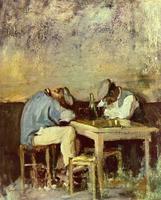
Two Drunks
Nicolae Grigorescu
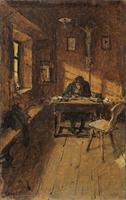
The Village Scribe
August von Pettenkofen
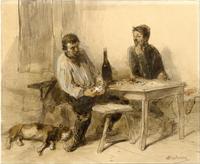
A Game of Cards
Clément-Auguste Andrieux
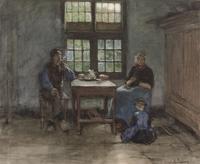
Larens binnenhuis
Anton Mauve
Wine Drinkers
Octav Bancila
Vilodagen
Albert Edelfelt
Der Zeitungsleser
Wilhelm Leibl
A Country Cobbler
Harriet Backer
Turks at the Cafe
Iosif Iser
Emile Gerstl (father)
Richard Gerstl
The Thankful Poor
Henry Ossawa Tanner
Peter I interrogates Tsarevich Alexei
Nikolai Ge
Drinking
Rudolf Schweitzer-Cumpana
Reprimand
Vladimir Makovsky
In the hut
Ilya Repin
Interior of a Tavern
Peder Severin Kroyer
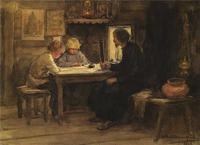
In a lesson of credence with the sexton
Ivan Vladimirov
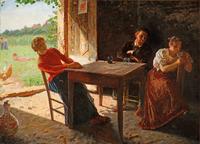
The card game
Noè Bordignon