Expert analysis of Camille Pissarro’s Peasant Planting Pea Sticks
Style: Impressionism · Genre: genre painting
Expert Analysis: "Peasant Planting Pea Sticks" by Camille Pissarro
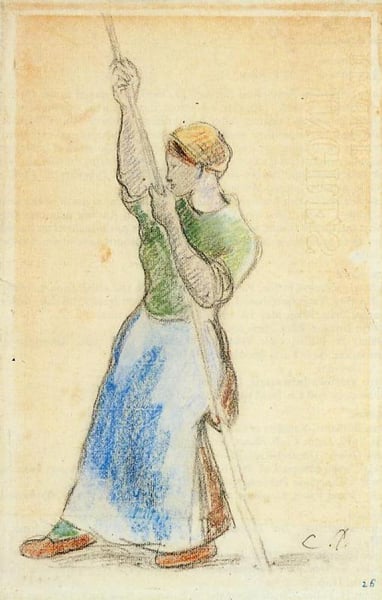
Camille Pissarro’s Peasant Planting Pea Sticks (c. 1880–1885) stands as a quintessential example of Impressionist genre painting, yet it transcends mere rural anecdote through its radical treatment of light, color, and human dignity. Painted at the height of Pissarro’s involvement in the Impressionist movement, this work captures a fleeting moment of agricultural labor with the spontaneity and optical realism that defined the group’s break from academic tradition.
Stylistic Significance
Pissarro employs broken, visible brushstrokes and a luminous palette—dominant greens, soft blues, and warm earth tones—to render the scene not as a static record but as a vibration of atmosphere. The pea sticks themselves become rhythmic vertical accents that echo the figure’s pose, while dappled sunlight filters through the canopy, dissolving form into patches of color. This technique, characteristic of high Impressionism, prioritizes the sensory experience over detailed narrative: the heat of the day, the rustle of leaves, the physical weight of labor.
Context within Impressionism
Unlike Monet or Renoir, who often depicted leisure or urban life, Pissarro consistently centered on rural workers—a subject that aligned with his anarchist sympathies and belief in the nobility of manual labor. Peasant Planting Pea Sticks is significant because it humanizes the peasant without sentimentality or allegorical pretense. The figure is anonymous, integrated into the landscape rather than highlighted against it, reflecting Pissarro’s conviction that labor is a natural, harmonious part of the environment.
Art-Historical Legacy
This painting exemplifies Pissarro’s role as a bridge between Realism and Impressionism. His focus on the repetitive, cyclical rhythms of farm work—planting, harvesting, tending—prefigures the later Post-Impressionist concerns of Van Gogh and Seurat. Moreover, the work’s emphasis on perceptual truth over academic composition influenced younger artists like Cézanne, who studied under Pissarro. By elevating a humble task—placing stakes for pea vines—into a study of light, motion, and quiet dignity, Pissarro affirms that the most enduring art can emerge from the most ordinary acts.
Museum / Gallery
Visually similar
20 works with related composition and palette
Peasant Woman
Camille Pissarro
Peasant with a Pitchfork
Camille Pissarro
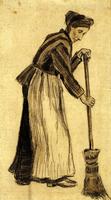
Woman with a Broom
Vincent van Gogh
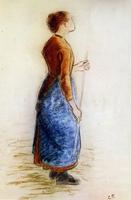
Study for the apple picker
Camille Pissarro
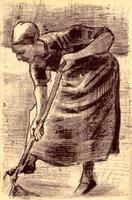
Woman Digging
Vincent van Gogh
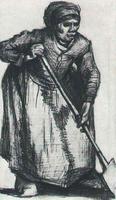
Peasant Woman with Spade
Vincent van Gogh
Peasant Woman with Broom
Vincent van Gogh
a Woman with a Basket
Hendrick Avercamp
Peasant study (Marguerite Moreau)
Jules Breton
Woman with a Broom
Vincent van Gogh
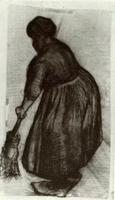
Peasant Woman with Broom
Vincent van Gogh
Girl striding out reading a book
Alexandre Antigna
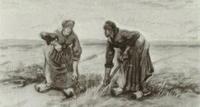
Two Women Talking to Each Other While Digging
Vincent van Gogh
Woman with basket
Cristiano Banti
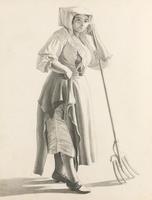
Italian girl
Giovanni Battista Lusieri
Illustrations for Mikhail Stelmakh's book "In the Hedgehog's Windmill"
Hryhorii Havrylenko
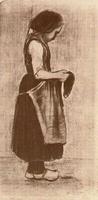
Peasant Girl Standing
Vincent van Gogh
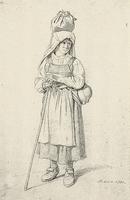
"Cervarola". Standing woman in traditional costume by Cervara, a tied pouch on her head and with a walking stick
Theodor Leopold Weller
They already go plucked
Francisco Goya
Two Seated Women in Conversation, One with a Staff
Jules Breton