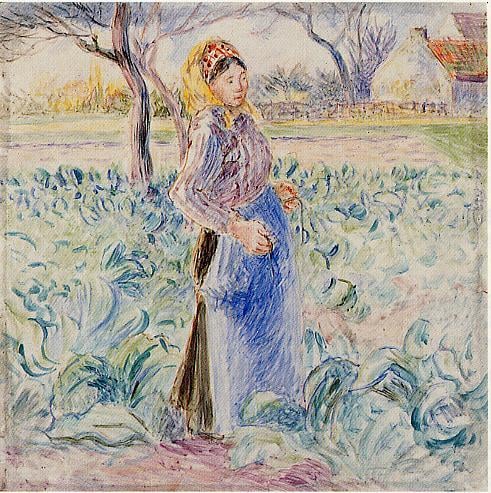
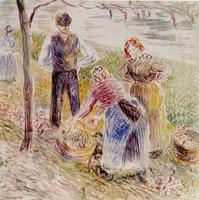
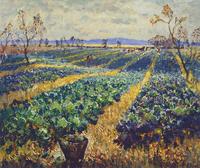
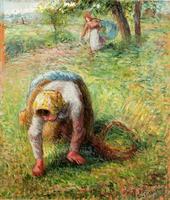
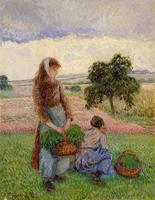
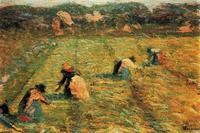
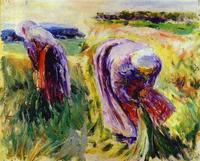
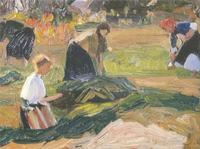
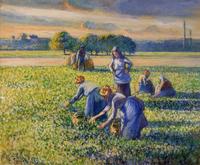
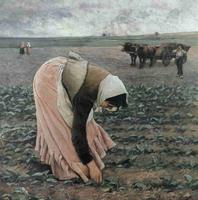
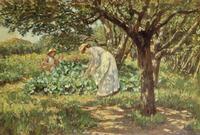
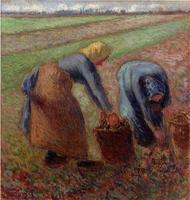
Based solely on the provided facts—that Camille Pissarro’s Peasant Woman in a Cabbage Patch is an Impressionist genre painting—its significance lies in how it epitomizes the core tenets of the movement while elevating a humble, everyday subject to artistic prominence.
As an Impressionist work, the painting is significant for its radical commitment to capturing transient visual sensations—likely the interplay of sunlight filtering through leaves, the varied greens of the cabbage patch, and the dappled shadows on the peasant woman’s figure. Pissarro, a key figure in the group, uses broken brushwork and a bright, airy palette to dissolve rigid outlines, making the scene feel immediate and alive. The subject—a peasant woman at labor in a vegetable patch—is a quintessential genre painting theme, but here it is treated not as a sentimental narrative or moral lesson (as in earlier academic art) but as a pure optical experience. By focusing on the how of seeing rather than the what of storytelling, Pissarro asserts that a cabbage patch is as worthy of sustained contemplation as a historical or mythological scene. This democratic vision—finding beauty and significance in the rhythms of rural life—is what makes the artwork a landmark of Impressionism and a powerful statement of the movement’s desire to record the authentic, fleeting modern world.