Expertenanalyse zu Camille Pissarros Portrait of Jeanne
Stil: Pointillism, Neo-Impressionism · Genre: portrait
Expert Analysis: Portrait of Jeanne by Camille Pissarro
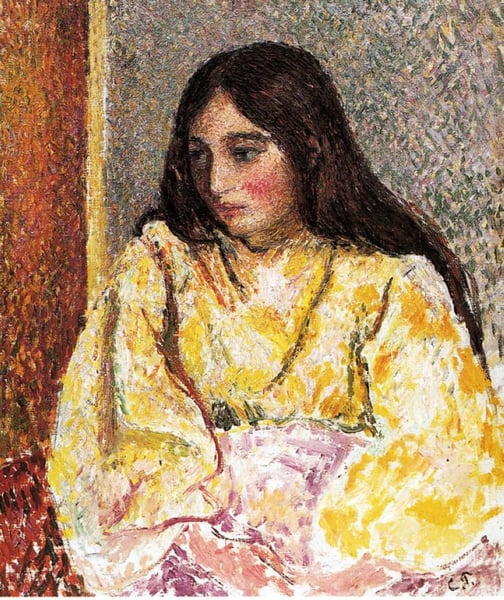
Camille Pissarro’s Portrait of Jeanne stands as a pivotal example of the artist’s brief but intense engagement with Pointillism and Neo-Impressionism—a stylistic turn that redefined portraiture within this rigorously scientific movement. While Pointillism is most often associated with landscapes and scenes of modern life, Pissarro’s decision to apply its systematic color-division technique to a human subject reveals the versatility and ambition of Neo-Impressionist theory.
Significance within Style and Period
-
Pointillism Applied to the Human Figure
Most Neo-Impressionist works (e.g., Seurat’s A Sunday on La Grande Jatte) focus on static, often idealized figures in outdoor settings. Pissarro’s Portrait of Jeanne brings the method indoors, translating its optical mixing of pure pigments into the soft folds of fabric, the warmth of skin tones, and the psychological presence of the sitter. The careful application of tiny, separate touches of color—rather than blended strokes—creates a vibrating, luminous surface that makes the portrait feel both intimate and scientifically observed. -
Pissarro’s Bridge Between Generations
As the oldest of the Impressionists, Pissarro’s embrace of Neo-Impressionism (c. 1885–1890) was a radical departure from his earlier, looser style. This portrait exemplifies his willingness to experiment with the younger generation’s theories—particularly those of Seurat and Signac—while retaining a humanist warmth absent from many of their more abstract treatments. Here, the Pointillist technique does not dehumanize the subject; instead, it lends a shimmering vitality to Jeanne’s features, suggesting Pissarro’s emotional connection to his daughter (likely Jeanne-Rachel, born 1881). -
Genre Extension
By applying pointillist techniques to portraiture—a genre traditionally reliant on smooth modeling and flesh tones—Pissarro challenged the notion that Neo-Impressionism was only suited to grand, static compositions. Portrait of Jeanne demonstrates how micro-dots of color can render contour, volume, and character, expanding the stylistic reach of the movement and influencing later portraitists who sought to merge scientific color theory with personal expression.
In sum, Portrait of Jeanne is significant not only as a rare pointillist portrait but also as a testament to Pissarro’s role as a stylistic innovator, proving that even a rigorous technique like divisionism could capture the quiet dignity of an individual face.
Museum / Gallery
Visuell ähnlich
20 Werke mit ähnlicher Komposition und Farbpalette
Study of Young Farmers
Henri Martin
Girl in Profile
Gwen John
Tyttö Riekkalasta
Sallinen Tyko
A Girl. Sketch
Boris Kustodiev
Madame Vuillard Seated
Edouard Vuillard
Clissa Turned Left with Her Hand to Her Ear
Mary Cassatt
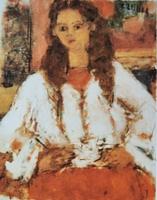
Czóbel Béla Lány Fehér Bluzban
Bela Czobel
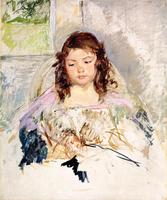
Sketch for 'Francoise in a Round Backed Chair, Reading' or 'A Girl in Pink'
Mary Cassatt
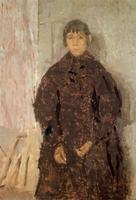
Girl in a Mulberry Dress
Gwen John
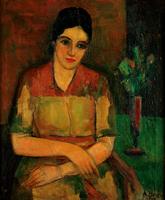
The Artist's Wife
Alexander Bogen
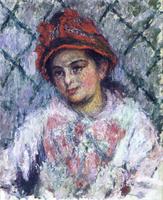
Blanche Hoschede
Claude Monet
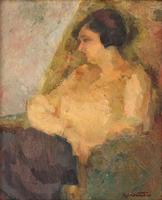
Aristocrat Portrait (Lila, Artist's Niece)
Francisc Sirato
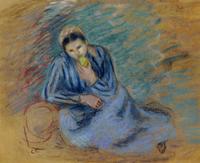
Seated Peasant Woman Crunching an Apple
Camille Pissarro
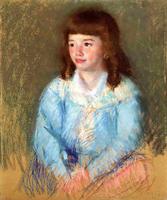
Young Boy in Blue
Mary Cassatt
Czóbel Béla Girl in Pink 1974
Bela Czobel
Self-Portrait
Marie Duhem
Portrait of Helene and Michette Guinotte
Theo van Rysselberghe
Seated Woman in White Dress
Helene Schjerfbeck
Bettina Bauer
Max Kurzweil
Adele Astaire
Oskar Kokoschka