Expert analysis of Camille Pissarro’s The Effect of Snow at Montfoucault
Style: Impressionism · Genre: landscape
Expert Analysis: The Effect of Snow at Montfoucault by Camille Pissarro
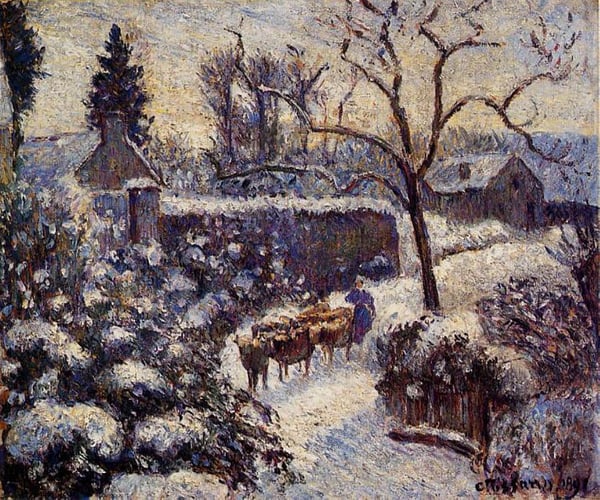
Camille Pissarro’s The Effect of Snow at Montfoucault (c. 1875) stands as a quintessential example of Impressionist landscape painting, demonstrating the movement’s radical break from academic conventions. Executed during a period when Pissarro was deeply engaged with the plein-air principles advocated by the Impressionist circle, the work embodies the core tenets of the style: direct observation of nature, the capture of transient atmospheric conditions, and a vivid, broken-color palette.
Significance within Impressionism:
-
Treatment of Light and Atmosphere: The painting’s title itself declares its focus on an ephemeral “effect”—here, the diffuse, silvery light of a snow-covered landscape. Pissarro avoids the traditional browns and grays of earlier snow scenes; instead, he uses a high-keyed palette of pale blues, lavender, pink, and white to convey the reflective quality of snow and the muted winter sun. This manipulation of color to suggest optical truth rather than local color is a hallmark of Impressionism.
-
Brushwork and Texture: Pissarro employs short, broken brushstrokes that build up the snow’s surface and the bare tree branches. The paint is applied in layered dabs and dashes, creating a vibrant, shimmering texture that mirrors the eye’s perception of light dancing on snow. This technique—visible, unblended strokes—was revolutionary at the time, prioritizing sensory experience over smooth finish.
-
Everyday Rural Subject: As a landscape, the work elevates a humble rural scene—a farm path near Montfoucault—to the status of high art. Pissarro’s choice reflects the Impressionist commitment to modern life and the natural world, rejecting historical, mythological, or didactic narratives. The stark yet serene winter scene captures a quiet moment, emphasizing the beauty found in the ordinary.
-
Pissarro’s Role as Mentor: Pissarro was a pivotal figure in the Impressionist movement, often called the “father” of the group. The Effect of Snow at Montfoucault exemplifies his influence on younger artists like Cézanne and Gauguin, who adopted his systematic approach to color and structure. His treatment of snow—as a luminous, colored surface rather than a white void—became a model for later Impressionist snowscapes.
Art Historical Context:
Pissarro’s snow scenes (he painted several in the 1870s) are especially significant because they test the Impressionist theory that all shadows and reflections are colored. In this work, the blue-violet shadows on the snow and the warm pinkish tones near the horizon demonstrate this principle. The painting’s loose, sketch-like finish also aligns with the movement’s emphasis on capturing the instant—the fleeting effect of a specific weather condition, time of day, and season.
In sum, The Effect of Snow at Montfoucault is not merely a landscape; it is a manifesto of Impressionist innovation. Through its luminous palette, lively brushwork, and devotion to atmospheric truth, it showcases Pissarro’s mastery of rendering the delicate, transient poetry of winter light.
Museum / Gallery
Visually similar
20 works with related composition and palette
Snow at Montfoucault
Camille Pissarro
Path in the Snow
Gustave Loiseau
Winter at Montfoucault 2
Camille Pissarro
Snow Effect in Montfoucault
Camille Pissarro
The Road to L'Hermitage in Snow
Camille Pissarro
House in Snow
John Henry Twachtman
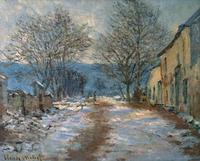
Snow Effect at Limetz
Claude Monet
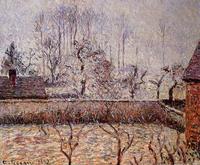
Landscape, Frost and Fog, Eragny
Camille Pissarro
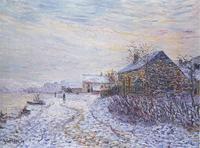
Snow Rifts Near the Seine
Gustave Loiseau
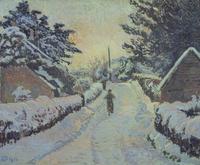
Ivy Cottage, Coldharbour. Sun and Snow
Lucien Pissarro
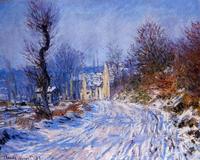
Road to Giverny in Winter
Claude Monet
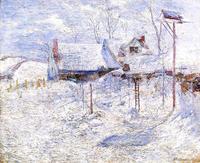
Last Touch of Sun
John Henry Twachtman
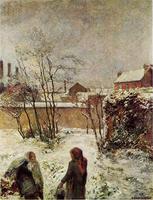
The garden in winter, rue Carcel
Paul Gauguin
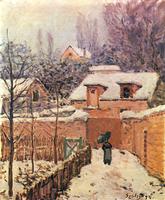
Garden in Louveciennes in the Snow
Alfred Sisley
Snow Effect at Veneux
Alfred Sisley
The red painted house
Gustave Loiseau
Frost
Claude Monet
House at Beynac
Gustave Loiseau
Snow Scene at Argenteuil
Claude Monet
Landscape
Pierre-Auguste Renoir