Expert analysis of Camille Pissarro’s The Rising Path, Pontoise
Style: Impressionism · Genre: landscape
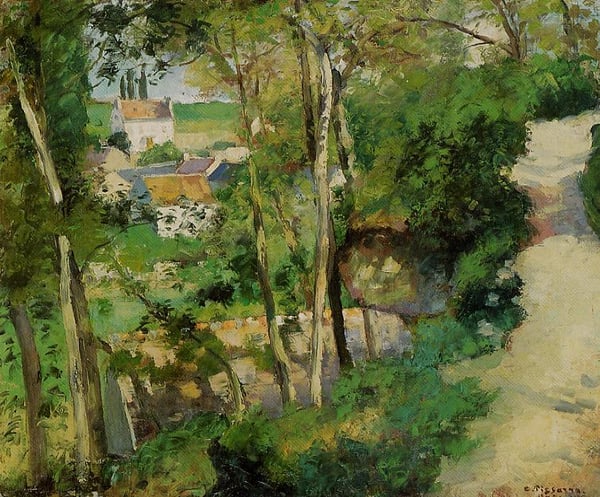
Camille Pissarro’s The Rising Path, Pontoise (c. 1875) exemplifies the Impressionist revolution in landscape painting by transforming a humble rural scene into a study of light, atmosphere, and modern vision. Painted during his most productive period in the village of Pontoise, the work showcases Pissarro’s commitment to plein air observation and his role as a mentor to younger Impressionists like Cézanne and Gauguin.
Significance within Impressionism:
- Ordinary subject elevated: Unlike the grand historical or mythological landscapes of the academies, Pissarro focuses on a winding dirt path ascending a hillside—a mundane view of peasant life. This “rising path” becomes a vehicle for exploring depth and recession through color, not linear perspective.
- Broken brushwork and optical mixing: The surface is built from short, separate strokes of pure, unmixed pigment—ochres, olive greens, soft blues, and flecks of white. These daubs optically blend when viewed at a distance, capturing the shimmer of sunlight filtering through foliage and the momentary haze of a breezy day.
- Atmospheric unity: Pissarro unifies the composition by bathing the entire scene in a silvery, diffused light. Shadows are not grey or black but woven from complementary hues (e.g., violet and pale blue), a hallmark of Impressionist color theory.
What Makes It Significant in Pissarro’s Oeuvre:
- The Rising Path, Pontoise belongs to a series of works from the same hillside, each recording a different time of day or weather. This serial approach—later taken up by Monet—highlights Pissarro’s scientific interest in temperature and light transitions.
- It embodies the “social” side of Impressionism: the path, built by rural labor, leads toward vegetable gardens and small houses, suggesting human presence without sentimentality. Unlike Monet’s fleeting effects, Pissarro’s landscapes often anchor the viewer in a stable, inhabited world.
Legacy: This painting demonstrates how Pissarro bridged the loose brushwork of early Impressionism with a compositional order—the diagonal path, the flanks of trees, the distant horizon—that influenced Post-Impressionists. It remains a quintessential example of how Impressionism found depth and beauty in the overlooked corners of ordinary life.
Museum / Gallery
Visually similar
20 works with related composition and palette
The Large Walnut Tree at Hermitage
Camille Pissarro
Auvers. View from Nearby
Paul Cezanne
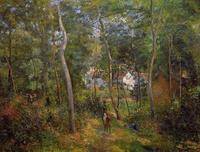
The Backwoods of l'Hermitage, Pontoise
Camille Pissarro
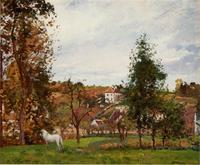
Landscape With A White Horse In A Field, L'Ermitage
Camille Pissarro
Landscape with a White Horse in a Meadow, L'Hermitage
Camille Pissarro
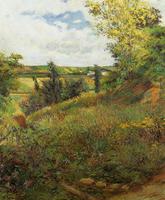
Gratte roosters path
Paul Gauguin
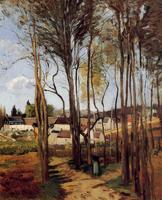
A Village through the Trees
Camille Pissarro
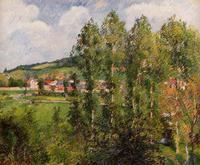
Gizors, New Section
Camille Pissarro
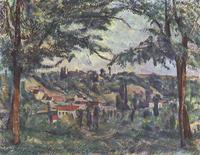
Landscape
Paul Cezanne
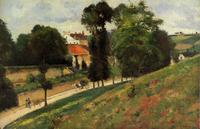
The Saint Antoine Road at l'Hermitage, Pontoise
Camille Pissarro
Landscape at l'Hermitage
Camille Pissarro
Path of Hermitage at Pontoise
Camille Pissarro
Road at Pontoise
Paul Cezanne
Road from Osny to Pontoise, Hoar Frost
Camille Pissarro
The valley of the Oise
Paul Cezanne
Еhe Red House
Theodore Robinson
Petit Breton arranging his shoe, or Landscape at Pont-Aven, Brittany
Paul Gauguin
Kitchen Gardens, Pontoise
Camille Pissarro
Resting in the woods Pontoise
Camille Pissarro
Near Rouen
Paul Gauguin