Analisi esperta di Narcissus and Tulips di Henri Fantin-Latour
Stile: Realism · Genere: flower painting
Expert Analysis: "Narcissus and Tulips" by Henri Fantin-Latour
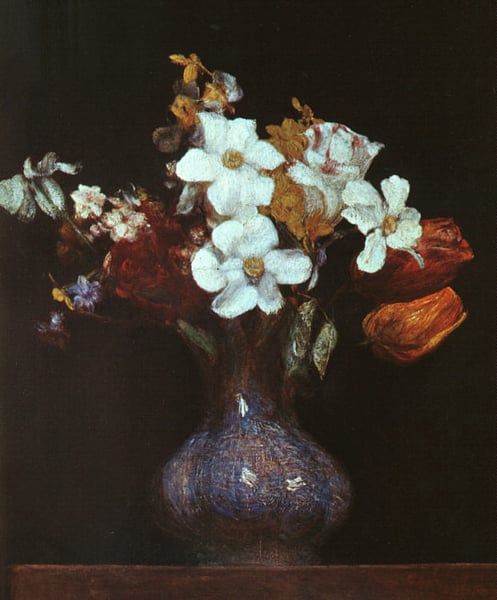
Style & Period Context (Realism) Henri Fantin-Latour was a master of Realism, a mid-19th-century movement that sought to depict subjects with objective, unidealized accuracy. In "Narcissus and Tulips," this commitment manifests in the meticulous rendering of petals, stems, and leaves—each botanical detail is observed with scientific precision. Unlike the looser brushwork of the Impressionists (who were his contemporaries), Fantin-Latour’s Realism insists on clear outlines, careful modeling of light and shadow, and a controlled, matte finish that emphasizes the tangible texture of flowers.
Genre Significance (Flower Painting) Within the genre of flower painting, Fantin-Latour revitalized a tradition that had become formulaic. While many still-life painters used flowers as decorative symbols, Fantin-Latour elevated the genre by treating each bloom as a distinct character. In "Narcissus and Tulips," the contrast between the upright, dignified tulips and the drooping, reflective narcissus creates a quiet drama. The composition is deceptively simple: a balanced arrangement that avoids excessive symmetry, allowing the viewer to appreciate the subtle variations in color—from the creamy whites and pale yellows of the narcissus to the deep reds or purples of the tulips.
What Makes This Work Significant
- Technical Mastery: Fantin-Latour’s ability to capture the velvety softness of tulip petals and the waxy delicacy of narcissus blossoms without sacrificing naturalism is a hallmark of Realist flower painting. This work demonstrates his unparalleled skill in rendering translucency and light reflection.
- Psychological Undertone: The title "Narcissus" (the flower associated with the myth of self-love) subtly introduces a layer of introspection. The pairing with tulips—often symbols of fleeting beauty—suggests a meditation on vanity and mortality, typical of the vanitas tradition but executed through a strictly Realist lens.
- Bridge Between Traditions: This painting exemplifies how Fantin-Latour bridged the academic tradition of detailed still life with the emerging modern interest in immediate perception. His work was highly influential for later artists who sought to combine rigorous observation with poetic sensibility.
In summary, "Narcissus and Tulips" is significant because it transcends mere botanical illustration, using Realist techniques to infuse a classic floral subject with quiet emotion and timeless elegance.
Museum / Gallery
Visivamente simili
20 opere con composizione e palette affini
Flowers Camelias and Tulips
Henri Fantin-Latour
Flowers
Henri Fantin-Latour
The bouquet in Delft
Diogène Maillart
Flowers in a Vase
Paul Cezanne
Still Life with Flowers
Julian Alden Weir
Still Life with Peonies
T. C. Steele
Bouquet of Flowers
Odilon Redon
Flowers
Henri Fantin-Latour
Vase of Flowers
Edouard Vuillard
Bouquet. Abramtzevo
Viktor Vasnetsov
Bouquet of Flowers in a Crystal Vase
Henri Matisse
The Red Poppy
Odilon Redon
Bouquet of flowers
Gustave Courbet
Winter Still Life with Candle
Mary Fedden
June Glory
T. C. Steele
Still Life with Apples and Flowers
Gheorghe Petrascu
Peonies
Samuel Peploe
Flowers in a Vase
Pierre-Auguste Renoir
Vase with Field Flowers
Octav Bancila
Vase of Flowers
Odilon Redon