Analisi esperta di Truth di Henri Fantin-Latour
Stile: Symbolism · Genere: allegorical painting
Expert Analysis: "Truth" by Henri Fantin-Latour
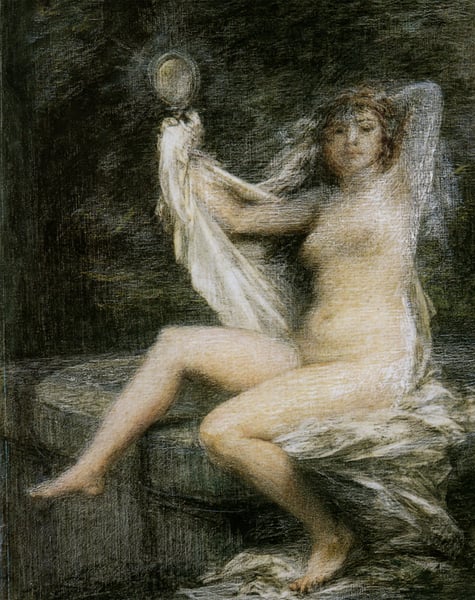
Henri Fantin-Latour’s Truth stands as a compelling allegorical work within the Symbolist movement, a period that sought to transcend literal representation in favor of inner meaning, emotion, and metaphysical ideas. Though Fantin-Latour is best known for his still lifes and group portraits—such as Homage to Delacroix—his allegorical works like Truth reveal a quieter, more introspective side of his practice, one that aligns him with the Symbolist preoccupation with universal themes rendered through personal, often dreamlike imagery.
Allegorical Tradition and Symbolist Innovation
The allegory of Truth typically personifies the concept as a female figure, often nude or draped, sometimes holding a mirror or a sun-like symbol representing clarity. Fantin-Latour’s interpretation avoids the dramatic fervor of earlier Romantic or Baroque depictions (e.g., by Goya or Rubens). Instead, he presents Truth as a calm, luminous presence—subdued, meditative, and almost elusive. This reflects the Symbolist emphasis on suggestion over declaration: Truth is not proclaimed but is felt as a quiet, inner revelation. The painting’s palette is muted, leaning on soft earth tones and cool greys, with a single source of light that emanates from the figure’s visage, blurring the boundary between physical form and ethereal aura.
Significance within Fantin-Latour’s Oeuvre and Symbolism
What makes Truth significant is its synthesis of academic draftsmanship with Symbolist ambiguity. Fantin-Latour’s training in the Louvre gave him a masterful command of form, yet here he uses that precision to dissolve the figure into a haze of paint strokes—a technique akin to the sfumato of Leonardo, but applied to an allegorical subject that resists easy interpretation. This tension between clarity and obscurity is central to Symbolist aesthetics: Truth is not a fixed, accessible entity but a mystery to be contemplated.
Furthermore, the work demonstrates Fantin-Latour’s unique position among his contemporaries. While Symbolists like Gustave Moreau and Odilon Redon created highly ornate, mythological fantasies, Fantin-Latour brought a sense of intimate stillness to allegory, as if the viewer has stumbled upon a private vision. Truth thus serves as a bridge between the idealism of academic painting and the emerging modernist interest in subjective experience, making it a quietly radical statement within the 19th-century avant-garde.
Museum / Gallery
Visivamente simili
20 opere con composizione e palette affini
Frauenakt
Károly Lotz
A Seating Bather
Pierre-Auguste Renoir
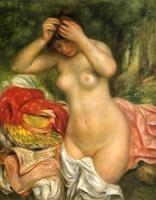
Bather Arranging her Hair
Pierre-Auguste Renoir
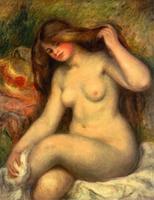
Large Bather with Crossed Legs
Pierre-Auguste Renoir
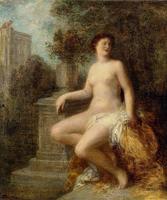
Bathsheba
Henri Fantin-Latour
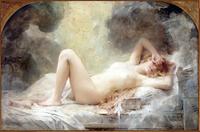
Danaé et la pluie d'or
Léon-François Comerre
Sleeping woman
Pierre-Auguste Renoir
The Spring
Pierre-Auguste Renoir
Bather
Pierre-Auguste Renoir
Bather with Long Hair
Pierre-Auguste Renoir
Mystical dream
Eliseu Visconti
Seated Bather
Pierre-Auguste Renoir
Perseus and Andromeda
Gustave Moreau
Bather
Pierre-Auguste Renoir
Spring nymph
Egisto Ferroni
Venus Bathing
Camille Corot
Seated Nude
Theophile Steinlen
Nude lying down
Giovanni Boldini
Lfr,"nu Au Voile"
Albert Aublet
Woman at the fountain
Pierre-Auguste Renoir