Analisi esperta di Portrait of Olimpiada Aleksandrovna Ryumina di Orest Kiprensky
Stile: Romanticism · Genere: portrait
Expert Analysis: "Portrait of Olimpiada Aleksandrovna Ryumina" by Orest Kiprensky
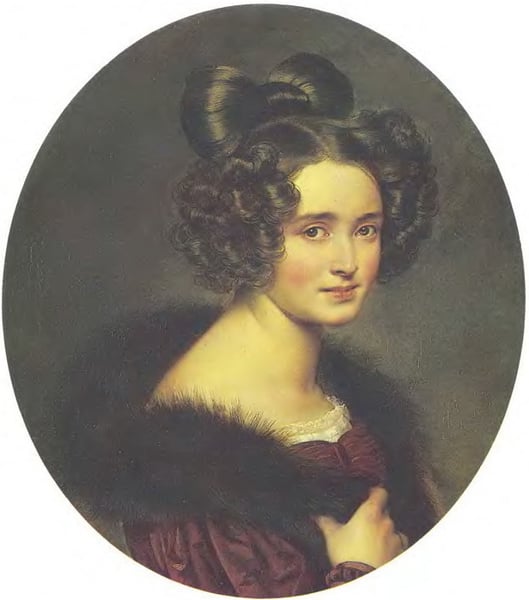
Orest Kiprensky stands as one of the most important figures in Russian Romantic portraiture, and his portrait of Olimpiada Aleksandrovna Ryumina exemplifies the key ideals of the Romantic movement within the genre. Painted during the early 19th century—a period when Russian art was increasingly engaging with European Romanticism—this work is significant for its psychological depth, its celebration of individual identity, and its masterful use of painterly technique to convey inner life.
Romantic Emphasis on Individuality and Emotion
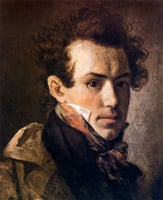
Unlike the formal, idealized court portraits of the preceding Neoclassical era, Kiprensky’s portrait focuses on the sitter’s personal character and emotional state. Olimpiada Aleksandrovna Ryumina is not presented as a static social symbol but as a living, thinking individual. Her direct, slightly introspective gaze and the subtle tilt of her head suggest a private moment of reflection—a hallmark of Romanticism’s fascination with the inner self. The soft, almost melancholic expression, combined with the warm but subdued light falling across her face, invites the viewer to contemplate her thoughts and feelings, making the portrait an intimate psychological study.
Technical Mastery and Painterly Style
Kiprensky’s brushwork demonstrates a Romantic preference for expressive texture over smooth, linear precision. The handling of fabric—the shimmering silk or velvet of her dress—is rendered with loose, confident strokes that catch the light, while the background remains dark and undefined, focusing all attention on the sitter’s face and upper body. This dramatic chiaroscuro, reminiscent of Rembrandt, is a Romantic device used to heighten the sense of mystery and interiority. The skin tones are built up with delicate glazes, creating a lifelike warmth that makes the portrait feel both immediate and timeless.
Significance within Russian Romanticism
Kiprensky was a pioneer in bringing the Romantic portrait’s emphasis on individual psychology to Russian art. In this work, he bridges the European Romantic tradition—influenced by artists like Ingres and Géricault—with a distinctly Russian sensibility: a quiet, dignified introspection that avoids the more theatrical emotionalism found in some Western Romantic works. The portrait of Olimpiada Aleksandrovna Ryumina is thus a key example of how Kiprensky elevated the portrait genre from mere likeness to a vehicle for exploring human character, marking a turning point in Russian portraiture and solidifying his legacy as a master of Romantic expression.
Visivamente simili
20 opere con composizione e palette affini
Frances Teresa Stuart, Duchess of Richmond and Lennox
Charles Turner
Sophia Frederia of Wurtemberg
Franz Xaver Winterhalter
Frances Teresa Stuart, Duchess of Richmond and Lennox
Charles Turner
The Countess of Darnley
Thomas Lawrence
Portrait of a Lady
Alexander Clarot
Countess Elisaveta Ksaverevna Vorontsova
George Dawe
Portrait of V.N.Surovtseva
Fyodor Rokotov
Ekaterina Bakunina
Orest Kiprensky
Frances Teresa Stuart, Duchess of Richmond and Lennox
Charles Turner
Catherine the Great
Marie-Gabrielle Capet
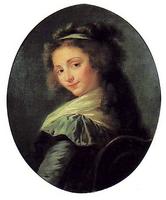
German opera singer Elisabeth Mara
Louise Elisabeth Vigee Le Brun
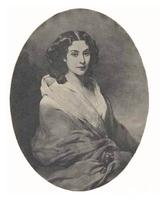
Sofia Gagarina
Franz Xaver Winterhalter
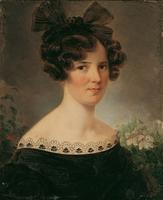
Therese Rockert
Peter Fendi
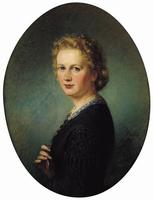
Portrait of a Lady
Eduard Ender
Portrait of Princess Elizaveta Alexandrovna Tchernicheva
Franz Xaver Winterhalter
Portrait of Princess A.A.Dolgorukaya
Fyodor Rokotov
Portrait of Countess Luigia Douglas Scotti d'Adda
Francesco Hayez
Portrait of Countess Knut
August Schiøtt
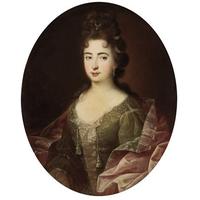
Portrait of a Noblewoman
Jean-François de Troy

Maria Leopoldine of Austria
Friedrich Johann Gottlieb Lieder