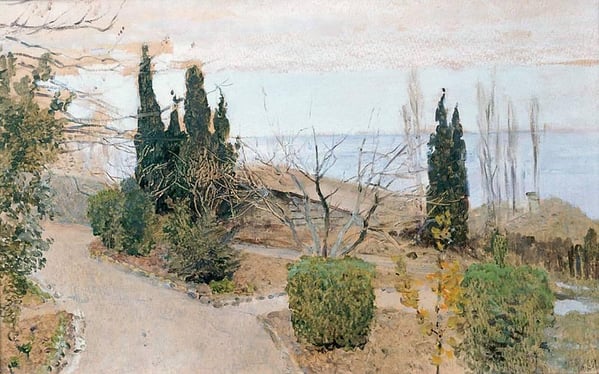
Expertenanalyse zu Isaac Levitans Garden in Yalta. Cypress trees.
Stil: Impressionism · Genre: landscape
Expert Analysis of Isaac Levitan’s “Garden in Yalta. Cypress trees.”
Isaac Levitan, the preeminent master of Russian lyrical landscape, painted “Garden in Yalta. Cypress trees.” during his final years—a period marked by a significant stylistic shift that aligns with the broader tenets of Impressionism. While Levitan is often celebrated for his melancholic, deeply atmospheric depictions of the Russian heartland, this work stands out as a vivid departure, revealing his embrace of the Impressionist fascination with light, color, and the sensory experience of a specific place.
Context and Significance within Impressionism
Painted in 1900 during a sojourn in the Crimea (a region that offered a dramatically different climate and palette from his native Central Russia), this landscape represents Levitan’s response to the brilliant southern sun and the exotic flora of Yalta. For an artist who had long been known for his “mood landscapes” (peyzazh nastroeniya)—often suffused with quiet melancholy or spiritual contemplation—“Garden in Yalta” signals a radical opening to the more decorative, hedonistic side of Impressionism. It is a work of pure light and color, less concerned with narrative emotion than with optical truth.
Visual and Stylistic Analysis
The composition is dominated by the vertical, slender forms of cypress trees, their deep green silhouettes slicing upward against a luminous sky. Levitan applies the Impressionist technique of broken color: the leaves are not painted as solid masses but as touches of varied green, yellow-green, and even blue, capturing the flickering effect of sunlight filtering through the foliage. The background, probably the sea or a distant mountain range, is rendered in soft, airy blues and purples, dissolving into the atmosphere—a hallmark of plein-air Impressionism.
Crucially, Levitan softens the contours. Unlike the crisp, linear clarity of his earlier works (influenced by the Barbizon school and Russian Realism), here the forms are allowed to blur at the edges, suggesting the vibrancy of a scene perceived in an instant. The bright, almost pastel palette—with warm ochres in the garden soil and cool violets in the shadows—shows Levitan’s study of Claude Monet’s late works, yet it retains a distinctively Russian lyricism: the cypresses are not merely decorative; they stand as serene, almost sculptural sentinels, giving the fleeting impression a sense of quiet dignity.
What Makes It Significant
-
A Turn Toward Late Impressionism: This painting marks Levitan’s most unambiguous engagement with Impressionist principles of light and color, moving away from the darker, more socially engaged realism of his contemporaries (like the Wanderers). It demonstrates that Russian Impressionism could be as vibrant and optically adventurous as its French counterpart, while still retaining a unique sensitivity to place.
-
Geographic and Emotional Contrast: For Levitan, Yalta was a land of “radiant shadows.” This work contrasts sharply with his iconic, somber evocations of the Volga or autumn forests. It reveals an artist at the end of his life embracing the joy of pure visual sensation—a final, brilliant extension of his range before his untimely death in 1900.
-
Bridging Nature and Decoration: The cypress trees, a motif later taken up by numerous post-Impressionists (such as Van Gogh, though Levitan’s are far more serene), serve as a bridge between natural observation and ornamental pattern. The painting stands as a testament to Levitan’s ability to absorb international Impressionist vocabulary without losing his own voice—in this case, a voice that marries the fleeting with the eternal.
In “Garden in Yalta. Cypress trees.”, Levitan proves that Russian Impressionism was not merely a derivative school but a unique synthesis of radical French technique and profound Slavic sensitivity to nature. It is a work of luminous calm—a final, sun-drenched chord in the career of a master who helped define the modern Russian landscape.
Visuell ähnlich
20 Werke mit ähnlicher Komposition und Farbpalette
Flower Garden. Caucasus
Arkhyp Kuindzhi
The Little Bridge, Pontoise
Camille Pissarro
Coast of the Crimea
Ilya Mashkov
Landscape of the Moon's First Quarter
Paul Nash
Beginning of Springtime
Kimon Loghi
Cypress, April
Henri-Edmond Cross
Granada
John Singer Sargent
In the Garden
Henri Martin
Crimea.Gursuf
Konstantin Korovin
Under the apricot tree
Martiros Sarian
Le Golfe
Henri Manguin
View of Fiesole
William Merritt Chase
In the botanical garden
Martiros Sarian
The Cypresses at Cagnes
Henri-Edmond Cross
Garden at Eragny
Camille Pissarro
Fountain in Summer
Henri Martin
Alley at the Sea
Victor Puzyrkov
The Bay of Saint-Tropez
Maxime Maufra
Fountain
Henri Martin
The Flowered Terrace
Henri-Edmond Cross