Analisi esperta di Haymaking di Isaac Levitan
Stile: Realism · Genere: landscape
Artwork: Haymaking (c. 1890s) by Isaac Levitan Style: Realism Genre: Landscape
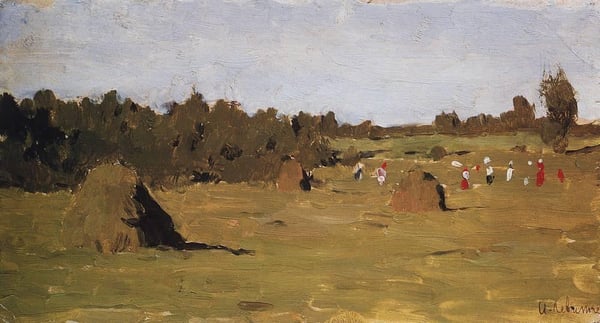
Isaac Levitan’s Haymaking exemplifies the pinnacle of Russian Realist landscape painting, where the artist transforms a humble rural chore into a profound meditation on nature’s rhythms. In this work, Levitan eschews dramatic narrative in favor of a quiet, almost silent moment: a broad meadow dotted with haystacks, a soft sky, and figures bent in labor. The significance lies in how Levitan harnesses the Realist commitment to truthful depiction while infusing it with a deeply personal, lyrical sensitivity.
What makes this artwork significant:
-
Mastery of light and atmosphere – Levitan captures the fleeting quality of a late-summer day. The golden light washes the field, while the sky holds a hint of humidity or approaching dusk. This observation of transient weather—a hallmark of Realism—creates an emotional resonance that transcends mere documentation.
-
Elevation of the ordinary – Rather than idealize peasant labor as heroic or picturesque, Levitan presents haymaking as an integrated part of the landscape. The human figures are small, almost swallowed by the vastness of the field and sky. This scale underscores a Realist worldview: humanity is part of a natural cycle, not its master.
-
Lyrical Realism – Levitan belongs to the generation of Russian painters who, following the Peredvizhniki (The Wanderers), used Realism to convey mood and social commentary without overt melodrama. In Haymaking, the serenity is tinged with a gentle melancholy—a signature Levitan quality. The repetitive, unglamorous work of the peasants is honored through the artist’s sensitive brushwork and muted palette.
-
Compositional harmony – The horizontal layering of the field, the distant tree line, and the sky creates a balanced, meditative structure. Levitan’s loose yet controlled brushstrokes suggest the texture of dry grass and moving clouds, anchoring the scene in sensory truth.
In sum, Haymaking is significant because it demonstrates how Realism, in Levitan’s hands, becomes a vehicle for poetic introspection. It captures not just a rural task, but the soul of the Russian landscape—its vastness, its quiet endurance, and the subtle unity of human effort and natural beauty.
Visivamente simili
20 opere con composizione e palette affini
Harvest
Zinaida Serebriakova
The Harvest at Montfoucault 2
Camille Pissarro
In Plyos
Isaac Levitan
Corn Stacks
Algernon Talmage
Study for The Harvest at Montfoucault
Camille Pissarro
Grain Field, Shinnecock Hills
William Merritt Chase
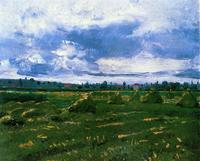
Wheat Fields with Stacks
Vincent van Gogh
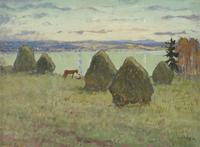
At Night
Konstantin Gorbatov
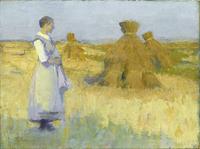
Etude
Theodore Robinson
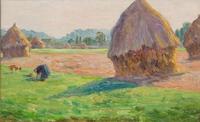
The Haystacks
Armand Guillaumin
Stacks of Wheat (End of Day, Autumn)
Claude Monet
Stacks of Wheat (End of Summer)
Claude Monet
Копиці
Trush Ivan Ivanovych
Harvest Field
Jane Sutherland
A Cornfield near Wooler
James Charles
Plateau Bromont at Pontgibaud (Puy de Dôme)
Armand Guillaumin
Haystacks
Mikhail Nesterov
Sheaves of corn
Firmin Baes
Cornfield at Ewell
William Holman Hunt
Landschaft mit Schloss
Josef Krachkovsky