Expert analysis of Isaac Levitan’s Huts after sunset
Style: Realism · Genre: landscape
Expert Analysis: "Huts after Sunset" by Isaac Levitan
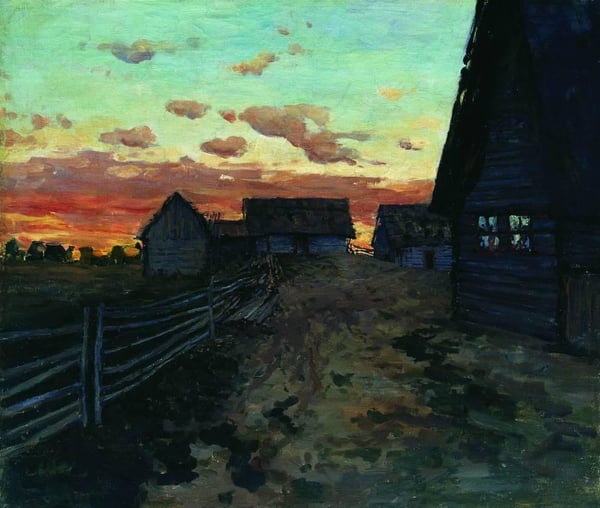
Isaac Levitan stands as one of the defining masters of Russian Realism, and Huts after Sunset exemplifies his profound ability to transform a humble rural scene into a deeply evocative meditation on light, mood, and the passage of time. Painted in the late 19th century, this work captures the quiet transition between day and night—a moment when the last warmth of the sun fades and the world settles into stillness.
Significance within Realism and Levitan’s Oeuvre
What makes Huts after Sunset significant is its masterful handling of atmospheric realism. Unlike the social or political critiques sometimes found in Realist painting, Levitan’s work focuses on the emotional truth of the landscape. Here, the huts—modest, wooden structures typical of rural Russia—become symbols of solitude and endurance. The "after sunset" light is rendered with extraordinary subtlety: the sky shifts from pale gold to deep violet and blue, while the dark silhouettes of the huts and surrounding trees anchor the composition. Levitan uses a restrained palette of earthy browns, muted greens, and lavender-grays, avoiding any dramatic contrasts. Instead, he builds a quiet harmony that invites contemplation.
The painting’s significance also lies in its place within Levitan’s broader exploration of the Russian countryside. He is credited with elevating the "mood landscape" (peyzazh nastroeniya) into a form of lyrical poetry. In Huts after Sunset, the absence of human figures heightens the sense of isolation and timelessness. The huts themselves seem to merge with the earth, their thatched roofs and weathered walls barely distinguishable from the darkening ground. This treatment emphasizes the deep connection between peasant life and the natural cycles of day and night—a core theme of Levitan’s work and one that resonated profoundly with his Russian audience.
Artistic Techniques and Realist Commitment
Levitan’s brushwork is deliberately soft and suggestive, typical of his later style. He applies paint in thin, layered washes, allowing the canvas texture to catch the light and create a sense of dusk’s diffusion. The horizon line is low, drawing the eye upward to the expansive sky, which occupies most of the canvas. In a true Realist fashion, Levitan avoids idealizing the scene: the huts are simple, even worn, and the landscape is unadorned. Yet through careful observation of light and color, he finds extraordinary beauty in the ordinary—a hallmark of his genius.
In the context of Russian Realism, Huts after Sunset stands as a testament to the movement’s capacity for deep psychological resonance. While contemporaries like Ilya Repin tackled social narratives, Levitan’s landscapes offered a different kind of realism: one rooted in the sensory and emotional experience of place. This painting, like his masterpiece Above Eternal Peace, shows how a quiet, unassuming motif can carry immense weight when seen through the eyes of a painter attuned to the subtle music of nature.
Museum / Gallery
Visually similar
20 works with related composition and palette
Huts
Isaac Levitan
Autumn landscape
Isaac Levitan
Entrance to the village
Isaac Levitan
The last rays of the sun
Isaac Levitan
Village Savvinskaya near Zvenigorod
Isaac Levitan
Landscape in the Kostroma region
Boris Kustodiev
Landscape with cottages
Konstantin Korovin
Golden autumn, village
Isaac Levitan
Evening
Isaac Levitan
Village. Twilight.
Isaac Levitan
Мартовская Ночь
Vitold Byalynitsky-Birulya
Patio
Konstantin Korovin
Sunny Day. A Village
Isaac Levitan
Dull day
Isaac Levitan
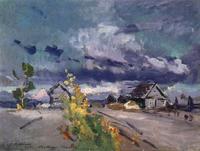
Okhotino.September
Konstantin Korovin
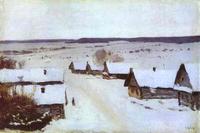
Village in Winter
Isaac Levitan
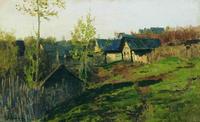
Isbas lighted by sun
Isaac Levitan
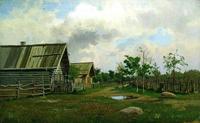
Rural Landscape
Efim Volkov
Village
Valentin Serov
Moonlit Night. A Village
Isaac Levitan