Analisi esperta di Landscape at Volga di Isaac Levitan
Stile: Realism · Genere: sketch and study
Expert Analysis: "Landscape at Volga" by Isaac Levitan
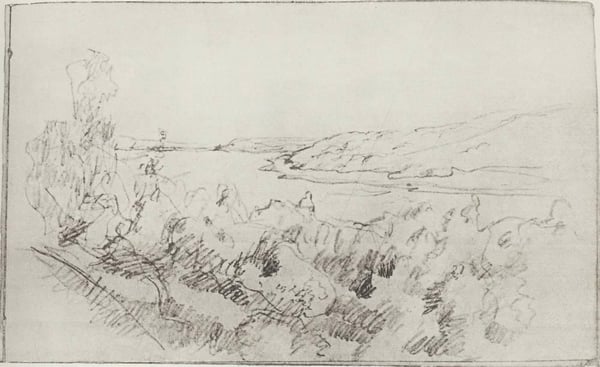
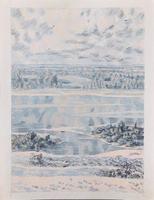
Isaac Levitan’s Landscape at Volga stands as a masterful exemplar of Russian Realist landscape painting, particularly within the intimate genre of the sketch and study. In this work, Levitan does not merely document a site; he captures the transient, atmospheric essence of the Volga River—a subject that held deep symbolic resonance for the Russian people as both a source of life and a symbol of vast, melancholic beauty.
Significance within Realism and the sketch/study genre:
-
Truth to Nature in its Rawest Form: As a sketch and study, this work bypasses the polished finish of a finished painting, offering instead a direct, unmediated record of the artist’s observation. The loose handling, rapid brushwork, and simplified forms are not signs of incompleteness but deliberate choices that prioritize authenticity over idealization. This aligns perfectly with the Realist credo of depicting everyday reality—here, the reality of light, air, and water on a specific day at the Volga.
-
Capturing Mood and Atmosphere: Levitan was a poet of mood, and this study excels in conveying a quiet, contemplative atmosphere. The muted palette, the subtle gradations of sky and river, and the broad, almost abstract treatment of the shoreline evoke a sense of boundless space and gentle melancholy. Even in a sketch, Levitan’s ability to infuse a landscape with emotional depth—a hallmark of Russian Realism—is fully evident.
-
A Window into Creative Process: The significance of Landscape at Volga is heightened by its nature as a study. It reveals Levitan’s working method: his reliance on direct observation, his sensitivity to changing light and weather, and his ability to distill a complex scene into essential visual notes. In the Realist tradition, such studies were not mere preparatory steps but finished works of art in their own right, valued for their immediacy and truthfulness.
-
Contribution to the Russian Landscape Tradition: Within the broader period of Russian Realism, Levitan transformed landscape painting by imbuing it with psychological resonance. This sketch, though modest in scale, embodies that transformation: it is a record not only of a place but of a state of being—the quiet, reflective soul of the Russian countryside. Its significance lies in how it elevates a fleeting, unassuming moment into a timeless, deeply felt experience.
In summary, Landscape at Volga is significant because it demonstrates the core Realist principle of fidelity to nature—especially in the pure, unmediated form of a sketch—while also showcasing Levitan’s genius for evoking profound emotional atmosphere through simple, truthful means. It is a testament to the power of a fragment: a quick study that holds the full weight of a master’s vision.
Visivamente simili
20 opere con composizione e palette affini
River floods, such as seas
Ivan Shishkin
Guernsey Landscape
Pierre-Auguste Renoir
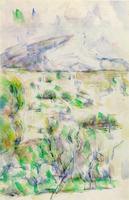
Mont Sainte-Victoire Seen from les Lauves
Paul Cezanne
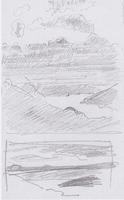
Lake Thun from the path to the plate Schynigen
Ferdinand Hodler
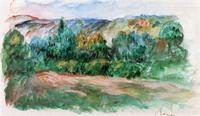
Essoyes Landscape
Pierre-Auguste Renoir
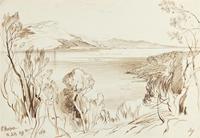
St. Hospice
Edward Lear
Heuvels aan de kust
Lucien Pissarro
Forest edge, rising of the moon/Forest edge, sun behind the clouds
Isaac Levitan
Lake Balaton Paradise (Hungary)
Maria Bozoky
Landscape
Theodore Rousseau
Landscape
Pierre-Auguste Renoir
“Paysage”
Ker-Xavier Roussel
High riverbank with boat and planned bridge
Isaac Levitan
Land by the Sea
Henri-Edmond Cross
Korsun
Hryhorii Havrylenko
Landscape near Bordiguera
Isaac Levitan
Egry József, Balaton Badacsonnynál
Egry József
Egry József. Öbölrészet 1944
Egry József
Mykhailivske
Hryhorii Havrylenko
Egry József, Badacsony,.
Egry József