
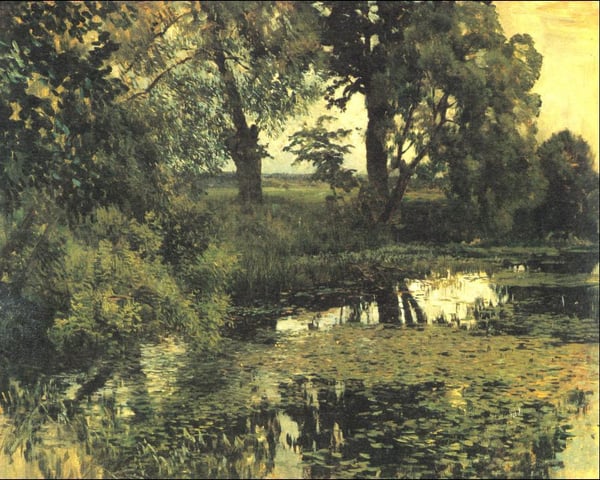
Analisi esperta di Overgrown pond di Isaac Levitan
Stile: Realism · Genere: landscape
Expert Analysis of Isaac Levitan’s "Overgrown Pond"
Isaac Levitan’s Overgrown Pond (1887) is a masterful example of Russian Realist landscape painting that transcends mere topographical accuracy to become a meditation on mood, transience, and the quiet power of nature. Within the tenets of 19th-century Realism, Levitan moves beyond the detailed depiction of a specific locale—here, a neglected pond choked with duckweed and surrounded by dense foliage—to evoke an almost palpable atmosphere of stillness, melancholic reflection, and the slow passage of time.
Significance within Realism and the Landscape Genre:
-
Psychological Depth through Nature: Levitan’s Realism is not about recording data; it is about feeling. Unlike earlier, more heroic or picturesque landscapes, Overgrown Pond presents a humble, even overgrown corner of the Russian countryside. The lack of human figures, the dark, murky water, and the dense, suffocating greenery create a sense of isolation and introspection. This is a landscape that “listens” and “remembers”—a hallmark of Levitan’s ability to infuse the natural world with human emotion (often called a “landscape of mood”). This approach was groundbreaking, elevating the ordinary rural scene to a vehicle for profound lyricism.
-
Mastery of Light and Atmosphere: Levitan was a peerless observer of atmospheric effects. In this painting, the light is diffused and dappled, filtering through the canopy of trees and reflecting dully off the pond’s surface. He uses a restrained, earthy palette—deep greens, browns, and muted grays—to capture the humidity and stillness of a late summer day. The subtle gradations of tone in the water and the dense, almost tangible texture of the vegetation demonstrate his technical brilliance within Realist practice: the illusion of reality is achieved not through painstaking detail, but through unified tonal harmony and the dynamic relationship between light and shade.
-
Symbolism and the “Overgrown” State: The central subject—the pond being reclaimed by vegetation—carries symbolic weight. It suggests nature’s quiet victory over human intention (perhaps an abandoned estate or a forgotten corner of a garden). This theme of oblivion and the persistence of the natural world was a recurring motif in Levitan’s later works, reflecting a broader fin-de-siècle Russian mood of melancholy and a deep, almost spiritual connection to the land. The “overgrown” quality is not merely descriptive; it is a philosophical statement about time, decay, and the eternal cycle of growth.
-
Place within Levitan’s Oeuvre and Russian Art: Overgrown Pond belongs to a series of intimate, lyrical landscapes that Levitan painted in the 1880s, solidifying his reputation as the poet of the Russian landscape. This work, with its subdued emotional resonance and focus on a non-monumental subject, stands in contrast to the more grandiose landscapes of his predecessor Alexei Savrasov or the later social narratives of the Wanderers. It reveals Levitan’s unique ability to find the sublime in the ordinary, influencing generations of later Russian painters who sought to blend realism with a nuanced, subjective vision.
Conclusion:
Overgrown Pond is significant not because it documents a specific place, but because it demonstrates how Realism can transcend mimesis to become a language of the soul. Through a masterful control of mood, light, and composition, Levitan transforms a simple, unremarkable spot into a resonant symbol of solitude, memory, and nature’s quiet endurance. It stands as a quintessential example of the “landscape of mood” that defines Levitan’s genius and his lasting contribution to the Realist tradition.
Visivamente simili
20 opere con composizione e palette affini
Overgrown Pond
Isaac Levitan
River
Volodymyr Orlovsky
A Bend in the River Oise
Charles-Francois Daubigny
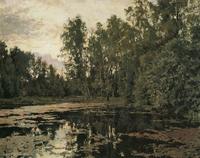
The Overgrown Pond. Domotcanovo
Valentin Serov
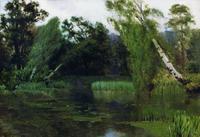
At the park
Isaac Levitan
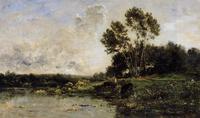
The Banks of the Oise
Charles-Francois Daubigny
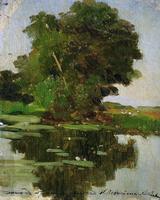
Overgrown pond
Isaac Levitan
The Swamp
Gustav Klimt
Pond in a Old Park
Ivan Shishkin
A tranquil river landscape
Louis Aston Knight
In the park
Ivan Shishkin

Pond at dusk
Aleksey Savrasov
Pond in Ochtir
Viktor Vasnetsov
Boat on a Pond
Charles-Francois Daubigny
Edge of the Pond
Charles-Francois Daubigny
Pond in Abramtsevo
Valentin Serov
Étang à Villeneuve
Henri Biva
Lonely tree at the Gein Sun
Piet Mondrian
A Silent Pool - Autumn
Edward Wilkins Waite
The lily pond
Adrien Moreau