Expertenanalyse zu Isaac Levitans Quiet cloister
Stil: Realism · Genre: sketch and study
Expert Analysis of "Quiet Cloister" by Isaac Levitan
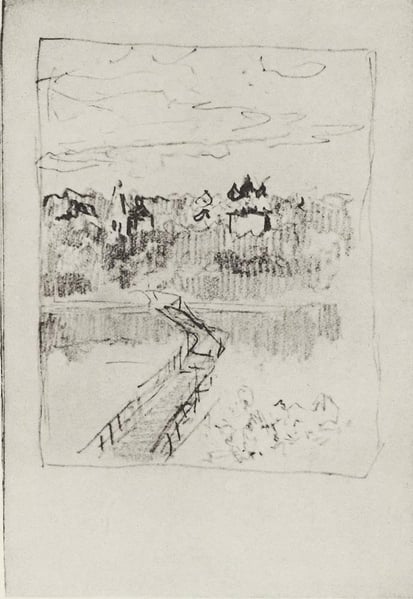
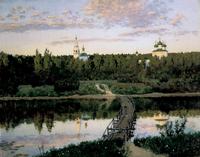
Isaac Levitan, a master of Russian Realism, is celebrated for his ability to infuse landscapes with profound emotional depth and a sense of spiritual quietude. "Quiet Cloister"—executed as a sketch and study—offers a rare, intimate glimpse into his working process while exemplifying the core tenets of his mature style.
Significance within Realism and Levitan’s Oeuvre
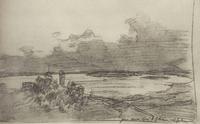
As a sketch, the work is significant for its directness and immediacy. Rather than a polished, finished painting, Levitan captures the essential mood of a secluded monastery or church with swift, economical brushstrokes. The "sketch and study" genre allows him to prioritize atmosphere over detail—a hallmark of his approach to Realism. Where many Realists focused on narrative or social commentary, Levitan used plein-air studies to render transient effects of light, shadow, and weather. In "Quiet Cloister," the soft, diffused illumination on the architectural forms and the surrounding foliage suggests a specific moment—perhaps late afternoon or early morning—when the world holds its breath. This emphasis on ephemeral natural phenomena aligns with the broader Realist pursuit of truth to perception, yet Levitan elevates it to a near-meditation on solitude and faith.
Artistic Techniques and Emotional Resonance
The composition likely uses a low horizon and a central or slightly off-center placement of the cloister, drawing the viewer’s eye upward toward the dome or bell tower. The sketchy handling of the bricks, trees, and sky creates a sense of atmospheric perspective, where the distance feels veiled in a hazy, silent air. Colors are probably subdued—soft grays, muted greens, pale ochre—underscoring the “quiet” of the title. This restraint is characteristic of Levitan’s later works, which evolved from more literal depictions into poetic, almost Symbolist expressions of Russia’s landscape and soul.
Context and Legacy
Levitan’s studies were not mere preparatory steps; they were embraced as finished artworks in their own right by collectors and fellow artists who valued his spontaneity. "Quiet Cloister" stands as a testament to his belief that a landscape could convey an inner, spiritual state—a concept that deeply influenced later Russian painting, including the Symbolists. In its modest scale and unpretentious genre, the work encapsulates the essence of Levitan’s genius: finding the eternal in the fleeting, and the sacred in the ordinary.
Visuell ähnlich
20 Werke mit ähnlicher Komposition und Farbpalette
Quiet cloister
Isaac Levitan
Quiet cloister
Isaac Levitan
Quiet cloister
Isaac Levitan
In the boat with the ink and metal pen
Alfred Freddy Krupa
Novgorod. Anthony the Roman. View from the river.
Pyotr Konchalovsky
Twilight in Sudislavl
Boris Kustodiev
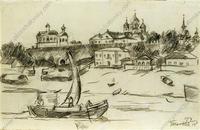
Veliky Novgorod. Kremlin.
Pyotr Konchalovsky
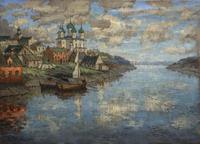
View from a River on Old Town
Konstantin Gorbatov
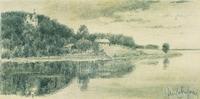
Plyos
Isaac Levitan
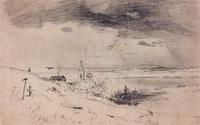
The old churchyard on the banks of the Volga
Aleksey Savrasov
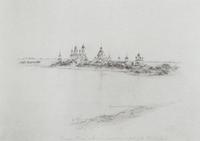
Saviour-Jacob Monastery in Rostov
Vasily Polenov
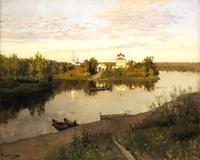
Vesper chimes
Isaac Levitan
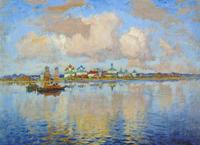
Rostov Veliky
Konstantin Gorbatov
Volkhov
Nicholas Roerich
Village with Two Figures
Konstantin Gorbatov
Before the thunderstorm
Isaac Levitan
The bridge at the mill
Konstantin Korovin
Morning in Uglich
Konstantin Yuon
Before the thunderstorm
Isaac Levitan
Rain
Vitaly Volkov