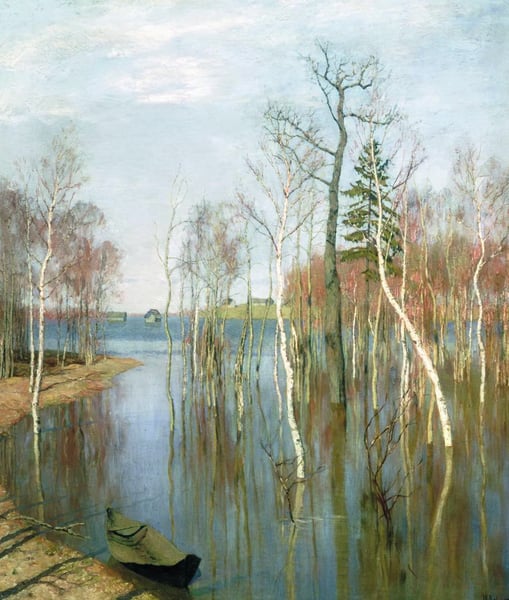
Spring. High waters.
Dettagli
Analisi esperta di Spring. High waters. di Isaac Levitan
Stile: Realism · Genere: landscape
Expert Analysis: Isaac Levitan’s “Spring. High Waters.”
Isaac Levitan’s “Spring. High Waters.” (often simply called Spring – High Water) is a quintessential work of Russian Realist landscape painting, executed in the late 19th century (circa 1897). Within the framework of Realism, Levitan transcends mere topographical accuracy; he infuses the natural scene with profound emotional and symbolic resonance, making this painting a touchstone for the psychological depth possible in landscape art.
Stylistic Significance within Realism
While adhering to the Realist mandate of depicting the observable world, Levitan chooses a deceptively simple subject: the vernal flooding of a river, with slender birch trees rising from the murky water. The composition is stark—a wide, pale sky dominates the upper half, while the swollen, silvery-brown river fills the lower half. A narrow strip of distant village roofs and a lone boat (perhaps a ferry) anchor the scene.
Levitan’s mastery lies in his handling of atmosphere. The sky, painted in soft, muted greys and whites, feels pregnant with thaw, yet it is not dramatic. The water, rendered with delicate, almost transparent brushwork, reflects the sky and the bare trees, blurring the boundary between solid and liquid. This is Realism not as photographic copy, but as a nuanced study of transient light and humidity. The artist captures the exact moment when snowmelt has turned the landscape into a silent, flooded plane—a liminal space between winter’s death and spring’s rebirth.
What Makes the Work Significant
-
Emotional Sublime in the Mundane: Levitan was a master of the “mood landscape” (paysage d’humeur). In Spring. High Waters., the flooding is not catastrophic; it is quiet, melancholic, and deeply peaceful. The isolated birch trees, their trunks rising from the water, evoke a sense of vulnerability and solitude. This was Levitan’s great contribution to Russian Realism: he proved that a simple, even bleak landscape could convey complex feelings—longing, transience, and the gentle sorrow of change.
-
Mastery of Light and Reflection: The painting is a study in how light behaves on water and wet earth. The sky’s soft glow is mirrored in the river’s surface, but Levitan avoids sharp contrasts; instead, he uses a nearly monochromatic palette of greys, silver-blues, and earthy browns. This restraint creates a hushed, meditative quality, making the viewer feel the weight of the heavy, damp air. It is a technical tour de force that influenced later Russian and Soviet landscape painters.
-
Thematic Resonance with Russian National Identity: The flooded birch grove is an archetypal Russian scene. Levitan’s treatment elevates this specific topography into a universal symbol of the Russian land: patient, resilient, and sorrowfully beautiful. The presence of the small hut and boat hints at human life in harmony with nature’s cycles, reinforcing the Realist interest in the everyday lives of ordinary people, but rendered with an almost spiritual reverence.
-
Precursor to Symbolism: Although strictly a Realist, Levitan’s work anticipated the Symbolist movement in its emphasis on mood and the ineffable. Spring. High Waters. is not just a record of a natural event; it is a meditation on time, impermanence, and the quiet poetry of the world. This duality—fidelity to nature fused with emotional depth—makes the painting a cornerstone of late-19th-century Russian art.
In summary, “Spring. High Waters.” is significant because it demonstrates how Realist principles can be pushed to express deep emotional and philosophical content. Levitan’s quiet, flooded landscape is a masterclass in atmosphere, restraint, and the power of nature to mirror human feeling—a feat that defined the pinnacle of Russian landscape painting.
Museum / Gallery
Visivamente simili
20 opere con composizione e palette affini
Evening, Canoe Lake
Tom Thomson
Landscape
Isaac Levitan
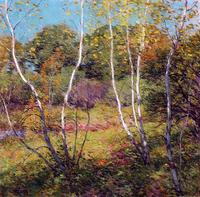
Waning Summer
Willard Metcalf
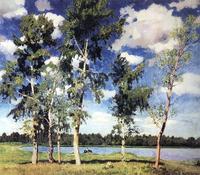
On the Lake
Igor Grabar
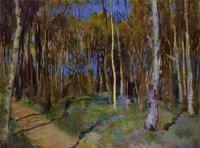
Spring. Martyshkino
Konstantin Somov
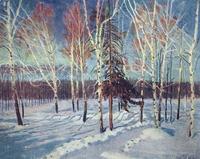
Winter Sunny Day
Igor Grabar
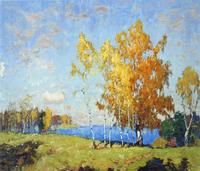
Autumn Landscape
Konstantin Gorbatov
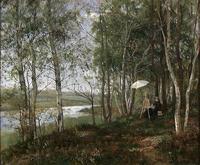
Landscape Cernay La Ville
Kitty Lange Kielland
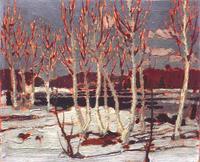
April in Algonquin Park
Tom Thomson
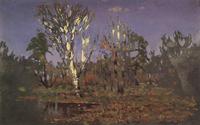
A grove with birch
Arkhyp Kuindzhi
Autumn
Isaac Levitan
Autumn Landscape
Konstantin Gorbatov
Kūstošais sniegs
Vilhelms Purvitis
Early Spring
Aleksey Savrasov
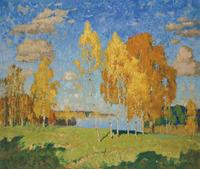
The Last Days of Summer
Konstantin Gorbatov
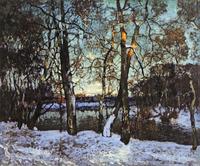
Winter Sunset
Konstantin Gorbatov
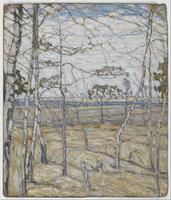
Birch Trees
Abraham Manievich
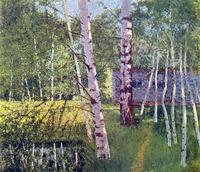
Birches in Summer
Igor Grabar
Birch grove
Isaac Levitan
Scenă mitologică
Kimon Loghi