Isaac Levitan の Stormy day の専門的な分析
スタイル:Realism · ジャンル:landscape
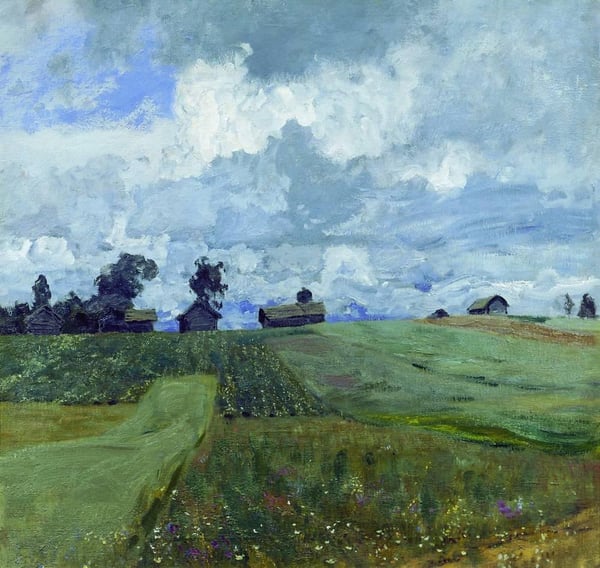
As an expert art historian, I will analyze "Stormy Day" by Isaac Levitan using only the provided facts—that it is a Realist landscape painting—to explain its significance within its style and period.
Expert Analysis: "Stormy Day" by Isaac Levitan
Isaac Levitan's "Stormy Day" stands as a quintessential example of Realism applied to the landscape genre, and its significance lies in how it transcends mere visual documentation to become a profound emotional and psychological statement. In the context of late 19th-century Russian Realism, Levitan elevated the landscape from a simple depiction of nature into a vehicle for expressing human mood and the spiritual condition of the nation.
Realism in Russian art was never a cold, objective copy of nature. Instead, it was deeply infused with a sense of truth—often a melancholic, introspective truth about life and the natural world. In "Stormy Day," this Realist commitment manifests not in precise, photographic detail, but in the honest representation of atmosphere and emotion. The "stormy" condition is not just a weather event; it is the subject itself. Levitan captures the transient, unstable quality of light, the weight of the clouds, and the wind’s movement across the landscape. This focus on transient atmospheric effects aligns with the Realist goal of capturing the fleeting moment—the impression of reality—but with a distinctly Russian solemnity.
Within the landscape genre, Levitan's work is significant because it rejects the idealized, picturesque views common in earlier academic painting. Instead, he portrays nature in its less "perfect" moments—a storm brewing, a damp, uneasy day. This choice reflects the Realist value of authenticity over beauty. The significance of "Stormy Day" is that it demonstrates how a landscape can express a narrative of impending change, unrest, or even a collective mood. For Levitan, the landscape was a mirror of human feelings; a stormy day could evoke loneliness, tension, or a profound connection to the vastness of the Russian countryside.
In summary, the significance of "Stormy Day" is its embodiment of Russian Realism's core innovation: using the landscape genre to infuse external nature with deep internal feeling. It moves beyond simple representation to become a sensitive, psychological study of mood, solidifying Levitan's role as a master of the "mood landscape" who captured the authentic, often turbulent, spirit of both nature and his time.
Museum / Gallery
視覚的に類似
構図やパレットが近い作品 20 件
Village Landscape
Karpo Trokhymenko
Landscape
Konstantin Yuon
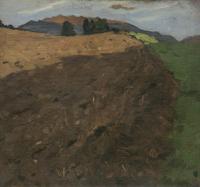
Tyrolean Landscape. Study for Der Sämann
Albin Egger-Lienz
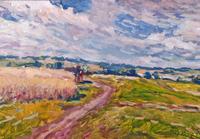
LANDSCAPE
JAROSLAV KELUC
Farm
Efim Volkov
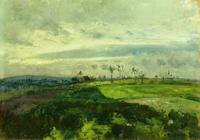
Rolling Landscape in Winter
Camille Pissarro
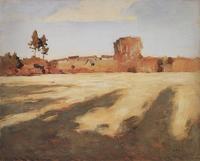
Field after Harvest.
Isaac Levitan
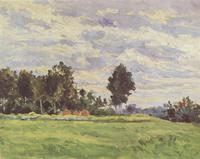
Landscape in the Ile de France
Paul Cezanne
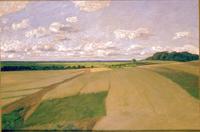
Weyerberg under the clouds
Hans am Ende
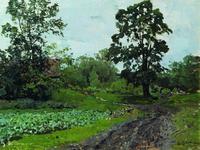
Road
Isaac Levitan
Sheds
Valentin Serov
Giverny Hillside
Guy Rose
Trail
Isaac Levitan
Landscape of Saarijärvi, Finland
Magnus Enckell
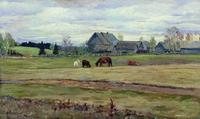
Dull day
Isaac Levitan
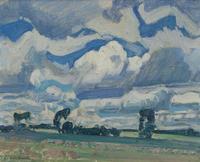
Fields and Sky
J. E. H. MacDonald
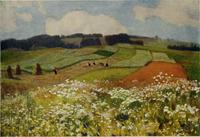
HAY-TIME, UPPER HUNGARY
Marianne Stokes
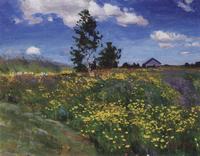
Blooming meadow
Arkady Rylov
HOT SUMMER LANSCAPE
JAROSLAV KELUC
Working the land
Paul Gauguin