
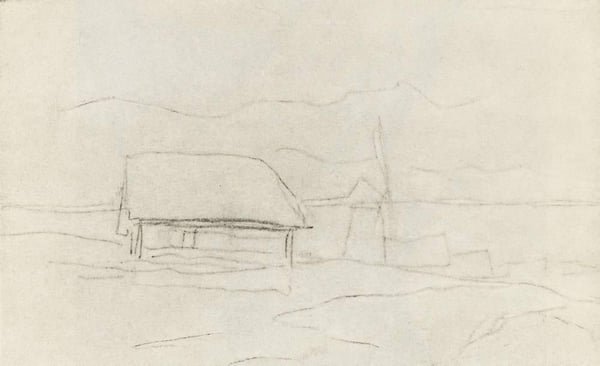
Expert analysis of Isaac Levitan’s Village. Windmill.
Style: Realism · Genre: sketch and study
Expert Analysis: Village. Windmill by Isaac Levitan
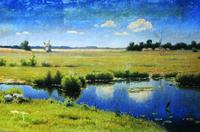
Isaac Levitan’s Village. Windmill is a compelling example of Russian Realist landscape painting, executed as a sketch and study. This work is significant for several reasons that illuminate both the artist’s method and the broader aims of the Realist movement in late 19th-century Russia.
First, the genre of sketch and study is crucial. Levitan, celebrated for his deeply atmospheric and psychologically resonant landscapes, often produced rapid, on-site studies to capture transient light, weather, and rural life. Here, the windmill and village are rendered with a freshness that prioritizes immediate visual truth over polished finish. The sketchy brushwork—likely broad, gestural strokes—conveys the texture of wooden structures, the weight of the sky, and the subtle shifts of earthy tones. This spontaneity is a hallmark of Levitan’s working process, revealing his commitment to “painting from nature” (plein air), a cornerstone of Realism that sought to depict the world as it is, not as idealized.
Second, the subject matter itself embodies the Russian Realist focus on humble, everyday rural scenes. Levitan consistently chose motifs that spoke to the quiet dignity and melancholy of the countryside—a windmill, a village path, a grey horizon. In Village. Windmill, the windmill is not a symbol of industry but a weathered, organic part of the landscape, blending into the soil and sky. This reflects the Realist conviction that the ordinary holds profound poetic and social meaning, especially in an era when Russia was grappling with industrialization and the fate of its peasantry.
Finally, the work’s significance lies in its anticipation of Levitan’s mature style—the “mood landscape” (peyzazh nastroeniya). Even as a study, the composition likely balances a muted palette with a strong sense of atmosphere, evoking a feeling of stillness or impending change. This ability to infuse a simple windmill with emotional depth prefigures his masterpieces such as Above Eternal Peace (1894) and March (1895). For art historians, Village. Windmill is a vital document of Levitan’s artistic process, demonstrating how Realist attention to truthful observation—even in the most transient sketch—could become the foundation for some of Russia’s most lyrical and enduring landscapes.
Visually similar
20 works with related composition and palette
El rancho (El Caney)
Armando Reveron
Field
Isaac Levitan
The Old Mill by Moonlight
Albert Pinkham Ryder
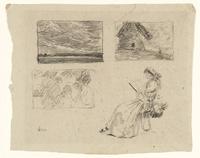
Studies of Landscapes and Figures
James Charles
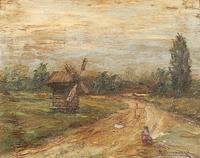
Літній пейзаж з вітряком
Микола Пимоненко
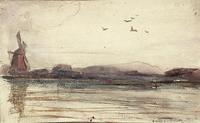
River Landscape with mill
Theo van Doesburg
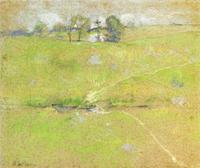
Path in the Hills, Branchville, Connecticut
John Henry Twachtman
Landscape near Bordiguera
Isaac Levitan
Thaw. Beginning of March
Aleksey Savrasov
Mills in the Neighbourhood of Dordrecht
Vincent van Gogh
Illustration for the magazine Education
Ivan Bilibin
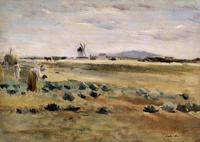
The Little Windmill at Gennevilliers
Berthe Morisot
Bela Adalbert Czóbel, Houses
Bela Czobel
Midvalue Horizon
Wolf Kahn
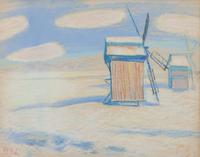
Windmills
Roman Selsky
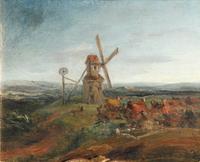
An Extensive Landscape with a Windmill
James Ward
Cloud
Nicholas Roerich
Landscape with Windmill
Georges Michel
Landscape with Haystacks
Constant Permeke
River in Ukraine
Efim Volkov