Expert analysis of Raphael’s The Virtues
Style: High Renaissance · Genre: allegorical painting
Expert Analysis: "The Virtues" by Raphael
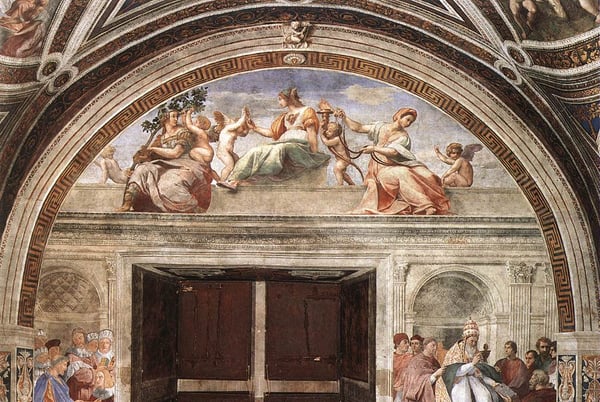
Raphael’s The Virtues (c. 1511) is a masterwork of the High Renaissance, painted as part of his celebrated fresco cycle in the Stanza della Segnatura in the Vatican. This allegorical painting exemplifies the era’s pursuit of harmony, clarity, and classical idealism, while also showcasing Raphael’s unparalleled ability to synthesize complex intellectual themes into a visually compelling composition.
What Makes It Significant
-
Synthesis of Classical and Christian Ideals
As an allegorical painting, The Virtues personifies the three theological virtues (Faith, Hope, and Charity) alongside the cardinal virtues (Fortitude, Temperance, Justice, and Prudence). Raphael seamlessly blends classical Greco-Roman figural ideals (derived from ancient sculpture and his studies of Leonardo and Michelangelo) with Christian iconography, creating a unified visual language that reflects the High Renaissance’s humanist embrace of both pagan wisdom and divine truth. -
Mastery of Composition and Spatial Harmony
The fresco is organized with Raphael’s trademark chiaroscuro and balanced symmetry. The virtues are arranged in a semicircular lunette, their poses echoing one another in a rhythm of standing, seated, and reclining figures. This creates a sense of serene stability, while the subtle contrapposto and gentle turns of the bodies convey a lifelike grace. The use of perspective—with the architecture of the fictive niche framing the figures—demonstrates Raphael’s command of illusionistic space, a hallmark of the High Renaissance. -
Psychological Depth and Noble Simplicity
Each virtue is distinguished by specific attributes (a torch for Faith, an anchor for Hope, children for Charity, etc.), but Raphael goes beyond mere labeling. Their expressions and gestures convey a universal, almost meditative calm. For instance, Hope looks upward with serene longing, while Charity gently embraces a child. This emotional clarity aligns with Giorgio Vasari’s praise of Raphael’s ability to make the “invisible visible”—a key contribution to Renaissance allegory. -
Integration with the Stanza della Segnatura’s Intellectual Program
The Virtues is the ceiling panel directly above the famous School of Athens and opposite the Disputation of the Holy Sacrament. Together with the Parnassus and Jurisprudence, it completes a quadrivium of human knowledge: theology, philosophy, poetry, and law. The virtues represent the moral foundations of justice and right action, linking earthly wisdom to divine law. This cohesive program marks the Stanza as one of the most ambitious intellectual and artistic projects of the High Renaissance. -
Influence on Later Allegorical Art
Raphael’s treatment of personified virtues—idealized yet accessible—became a template for subsequent generations, from Baroque ceilings to Neoclassical allegories. His fusion of naturalism with symbolic clarity set a standard for how abstract concepts could be rendered with both beauty and legibility.
In sum, The Virtues is significant not only as a jewel of Raphael’s Vatican frescoes but as a defining statement of the High Renaissance’s belief in the harmony of faith, reason, and aesthetic perfection.
Museum / Gallery
Visually similar
20 works with related composition and palette
The Mass of Bolsena, from the Stanza dell'Eliodor
Raphael
The Coronation of Charlemagne
Raphael
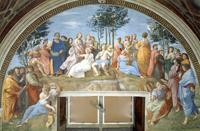
The Parnassus, from the Stanza delle Segnatura
Raphael
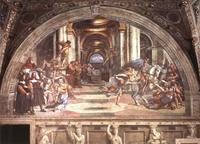
The Expulsion of Heliodorus from the Temple
Raphael
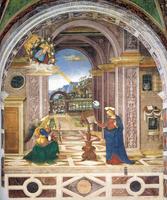
The Annunciation
Pinturicchio
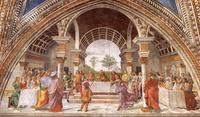
Herod's Banquet
Domenico Ghirlandaio
The Fire in the Borgo
Raphael
The Battle of Ostia
Raphael
The Hell
Luca Signorelli
The Ancestors of Christ: Achim, Eliud
Michelangelo
Blessing of the Faithful at Hippo
Benozzo Gozzoli
The Ancestors of Christ: Nahshon
Michelangelo
The Ancestors of Christ: Rehoboam, Abijah
Michelangelo
The Ancestors of Christ: Amminadab
Michelangelo
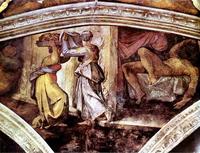
Sistine Chapel Ceiling: Judith Carrying the Head of Holofernes
Michelangelo
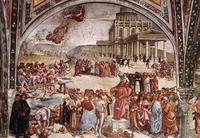
The Deeds of the Antichrist
Luca Signorelli
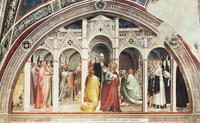
Cappella Rinuccini
Giovanni da Milano
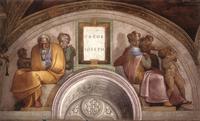
The Ancestors of Christ: Jacob, Joseph
Michelangelo
Pope Leo I Repulsing Attila
Raphael
The Ancestors of Christ: Abiud, Eliakim
Michelangelo