
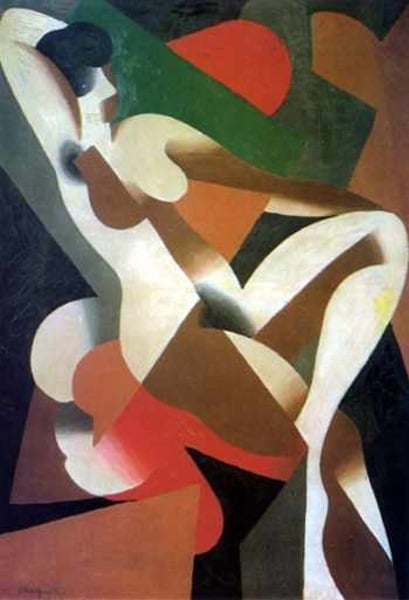
Donna
Dettagli
Analisi esperta di Donna di Rene Magritte
Stile: Cubism · Genere: nude painting (nu)
Expert Analysis: "Donna" by René Magritte
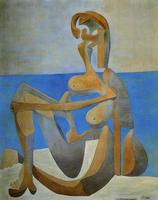
René Magritte is universally recognized as a leading figure of Surrealism, yet "Donna" belongs to his early years, a period of intense formal experimentation before he developed his signature dreamlike iconography. The supplied facts classify the work under Cubism—a surprising but revealing attribution. This painting is significant precisely because it documents Magritte's brief but crucial engagement with Cubist principles, offering a rare glimpse of the painter grappling with structure, fragmentation, and the dissolution of conventional perspective.
Cubist Deconstruction of the Nude:
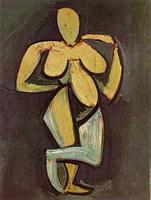
The nude (nu) genre is treated here with the Cubist vocabulary of faceted planes, simplified volumes, and a muted earth-toned palette. Rather than the sensuous, continuous contours of a classical nude, Magritte breaks the figure into angular, overlapping shapes. The title "Donna" (Italian for "woman") suggests a universal rather than a specific subject—a nod to Cubism's aim to represent an idea rather than a mere visual copy. The body is simultaneously shown from multiple viewpoints, a hallmark of Cubist space inherited from Picasso and Braque.
Significance in Magritte’s Evolution:
What makes "Donna" historically important is its role as a transitional work. In the early 1920s, Magritte was absorbing the lessons of Cubism and Futurism, but he was already beginning to subvert them. Unlike the analytical, almost scientific Cubism of Picasso, Magritte’s version here retains a strange, disquieting stillness. The figure does not fully dissolve into the background; its outlines remain somewhat legible, hinting at the tension between representation and abstraction that would later define his Surrealist trompe-l'œil.
Within Cubism's Legacy:
While Cubism typically aimed at a rational reconstruction of form, Magritte injects an element of mystery. The nude's anatomy is not just fragmented but subtly misplaced—a shoulder merging with a drape, a breast rendered as a flat geometric shape. This prefigures his later use of displacement and condensation (e.g., a train emerging from a fireplace). Thus, "Donna" stands as a footnote in Cubist history but a key early step in Magritte’s personal development: the moment when Cubist logic began to yield to a Surrealist illogic.
Conclusion:
"Donna" is significant not as a masterwork of high Cubism, but as a document of an artist in transition. It reveals Magritte testing the limits of a movement that would ultimately serve as a stepping stone toward his iconic explorations of reality, representation, and the uncanny. For scholars, it offers essential insight into how the foundations of Surrealism were laid upon the shattered planes of Cubism.
Genere
Stile
Visivamente simili
20 opere con composizione e palette affini
Three Women
Gustave Buchet
Composition
Gustave Buchet
Figure + House + Space
Lyubov Popova
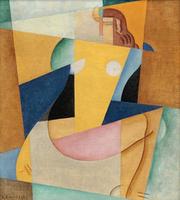
Sitting Woman
Vytautas Kairiukstis
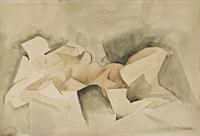
Nude
Emil Filla
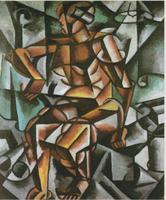
Seated Female Nude
Lyubov Popova
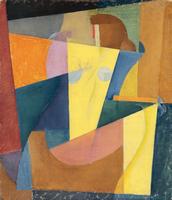
Kompozcija. Sėdinti Moteris
Vytautas Kairiukstis
Reclining woman
Pablo Picasso
Seated woman
Pablo Picasso
Model
Vladimir Tatlin
Donna + ambiente
Enrico Prampolini
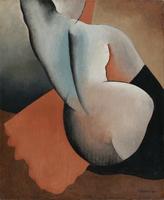
Nude seen from back
Gustave Buchet
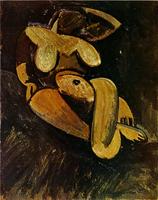
Reclining Nude
Pablo Picasso
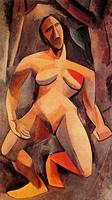
A driade (Nude in the forest)
Pablo Picasso
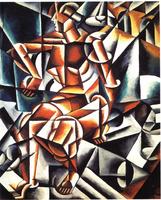
Air Man Space
Lyubov Popova
Standing female nude
Pablo Picasso
Removal
Andre Masson
Frauenakt
Gustave Buchet
Nude Combing Hair
Milton Avery
Seated bather on the beach
Pablo Picasso