
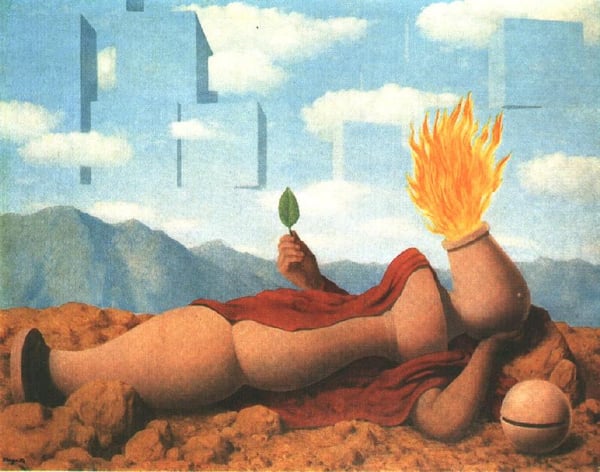
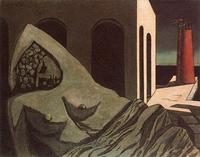
Elementary cosmogony
Dettagli
Analisi esperta di Elementary cosmogony di Rene Magritte
Stile: Surrealism · Genere: symbolic painting
Expert Analysis: "Elementary Cosmogony" by René Magritte
As a mature-period Surrealist work, "Elementary Cosmogony" is a quintessential example of Magritte’s symbolic painting—a genre in which he fused ordinary objects with disorienting contexts to challenge reality and perception.
Significance within Surrealism and Magritte’s Mature Period
- Juxtaposition of the Familiar and the Fantastic: Magritte’s mature period is marked by a shift from automatic techniques to meticulously painted, dreamlike scenarios. Here, he assembles elemental forms (e.g., a fish, a shell, a leaf, or a human torso) in an impossible, floating arrangement. This “elementary” cosmos reduces nature to isolated symbols, yet their non-logical placement subverts any clear narrative—a hallmark of Surrealist disruption of rational order.
- Symbolic Ambiguity: The painting’s title implies a rudimentary origin myth, but Magritte offers no explanation. The objects’ scale, orientation, and unexpected proximity create a visual paradox: the familiar becomes alien. This reflects Surrealism’s fascination with the unconscious, where logic dissolves and symbols carry multiple, often contradictory, meanings.
- Technical Mastery as Conceptual Tool: Unlike earlier Surrealists who embraced automatism, Magritte’s mature style employs precise, academic realism. The crisp detailing of each element makes the absurdity more unsettling—viewers cannot dismiss the scene as a mere sketch; they must confront the impossibility as a factual reality. This technique is central to Magritte’s influence on conceptual art.
Why It Stands Out
In the context of Surrealism’s evolution, "Elementary Cosmogony" exemplifies Magritte’s unique contribution: using the language of representation to question representation itself. By presenting a fragmented, non-narrative “cosmogony,” he suggests that the origins of meaning are not in nature but in the mind’s capacity to reorder symbols. The work remains significant as a bridge between the Surrealist dreamscape and the later ontological puzzles of Pop and Conceptual art.
Genere
Stile
Visivamente simili
20 opere con composizione e palette affini
Cicero
Rene Magritte
The Rights of Man
Rene Magritte
Désir d'été
Oscar Dominguez
Cicero
Rene Magritte
Nu dans la plaine de Rosas
Salvador Dali
Nocturne
Rene Magritte
Natural encounters
Rene Magritte
Nude on the Plain of Rosas
Salvador Dali
The Endless Enigma
Salvador Dali
Mural Painting for Helena Rubinstein (panel 2)
Salvador Dali
The Black Cloud
Odd Nerdrum
A famous man
Rene Magritte
Fashionable people
Rene Magritte
Woman, Old Man and Flower Femme
Max Ernst
The birth of idol
Rene Magritte
Head
Pablo Picasso
Seascape
Max Ernst
The Spectre of the Angelus
Salvador Dali
Lugano
Francis Bott
Ariana, the silent statue
Giorgio de Chirico