
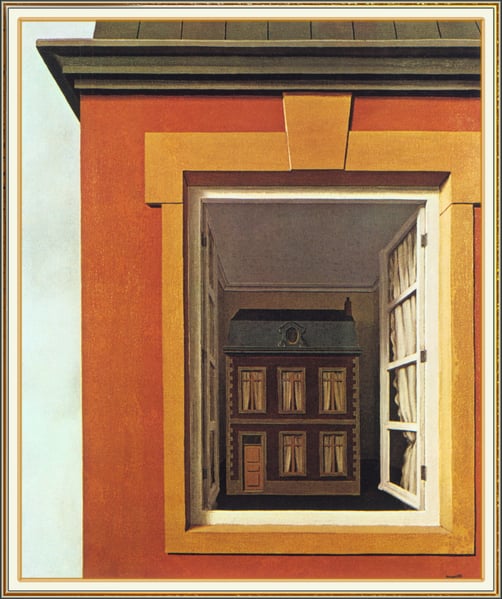
In Praise of Dialectics
Details
Expert analysis of Rene Magritte’s In Praise of Dialectics
Style: Surrealism · Genre: symbolic painting
This analysis of René Magritte’s In Praise of Dialectics is based solely on the provided structured facts: its Surrealist style, symbolic genre, and the Brussels pre-war and war years period.
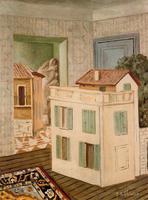
Within the context of Surrealism, Magritte’s work is distinguished by its use of precise, realistic representation to undermine reality. As a symbolic painting from the Brussels pre-war and war years (roughly the late 1930s to early 1940s), this piece reflects the period’s heightened sense of dislocation and contradiction. The title itself—invoking dialectics, a philosophical method of resolving contradictions—positions the artwork as a visual meditation on opposing forces.
The painting’s significance lies in how it embodies the Surrealist fascination with the “marvelous” through the disruption of ordinary perception. Magritte typically created what he called “reconciled opposites,” and here the window—a classic symbol of transition between interior and exterior—becomes a stage for irreconcilable paradoxes (e.g., day versus night, inside versus outside, presence versus absence). This visual puzzle forces the viewer to question the very nature of reality, a core Surrealist aim.
During the war years in Brussels, Magritte’s work often took on a more philosophical and conceptual turn, moving away from the psychological automatism of earlier Surrealism toward deliberate, intellectual puzzles. In Praise of Dialectics exemplifies this shift: it is not a dreamscape but a calculated collision of incompatible elements, rendered with meticulous realism. By forcing these contradictions into a single, stable image, Magritte makes the impossible seem plausible. The painting thus becomes a key example of how Surrealism could critique logic and reason from within the very language of objective representation, making it a significant milestone in the movement’s evolution during a dark historical moment.
Museum / Gallery
Visually similar
20 works with related composition and palette
A Summer Night's Melancholy
Michael Sowa
Window, Cour de Rohan
Balthus
The looking glass
Rene Magritte
The obsession
Rene Magritte
The empire of lights
Rene Magritte
Jobstijding
Carel Willink
Old Salford Street Scene
L. S. Lowry
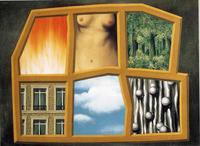
The six elements
Rene Magritte
The empire of lights
Rene Magritte
The mysterious barricades
Rene Magritte
Still Life and a Window
Arthur Segal
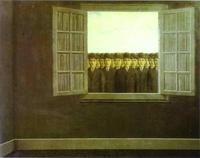
The month of the grape harvest
Rene Magritte
Vajda Lajos Windows on Szigetmonostor, 1935, Tempera on Cardboard, 45x45cm
Vajda Lajos
Man Who Went to the Office
Fernando Botero
The happy donor
Rene Magritte
The Strong Castle and the place of Andelys
Felix Vallotton
Act of violence
Rene Magritte
Woman at Her Window
Pierre Bonnard
South Carolina Morning
Edward Hopper
The house in the house
Giorgio de Chirico