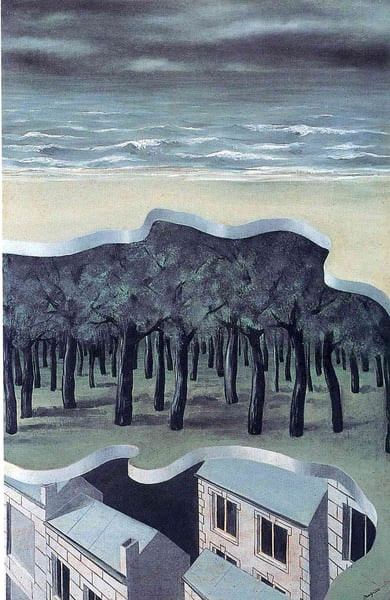
Popular panorama
Details
Expertenanalyse zu Rene Magrittes Popular panorama
Stil: Surrealism · Genre: symbolic painting
Expert Analysis of "Popular Panorama" by René Magritte
René Magritte's "Popular Panorama" stands as a quintessential example of his Surrealist output during the pivotal Surrealist Paris years—a period when the movement was crystallizing its exploration of the unconscious, dream logic, and the disruption of everyday reality. Executed in a style that marries meticulous realism with jarring irrationality, this symbolic painting embodies Magritte’s signature approach: using familiar, mundane objects to provoke a sense of mystery and intellectual disquiet.
Significance within Surrealism and the Period
-
Symbolic Language of the Everyday: Magritte deliberately chose banal, recognizable elements—a common street scene, a window, a landscape—and subverted their expected relationships. In "Popular Panorama," the title itself suggests a grand vista, but Magritte likely interrupted that view with a competing interior or an impossible detail (such as a painting within a painting, or an object obscuring the “panorama”). This technique aligns with the Surrealist mission to unlock the poetic potential of the ordinary, forcing viewers to question the stability of perception.
-
The Paris Years and Mature Surrealism: Created during Magritte’s time in Paris (1927–1930), when he fully engaged with André Breton’s circle, "Popular Panorama" reflects the movement’s turn toward what Breton called “convulsive beauty.” Unlike the dreamscapes of Dalí or the biomorphic forms of Miró, Magritte’s works from this period are deliberately static and photographic in finish, making their conceptual disruptions all the more startling. The painting’s symbolic nature—objects standing in for abstract ideas like visibility, boredom, or the gap between representation and reality—marks a high point of Surrealist philosophical inquiry.
-
Legacy of the “Panorama” Concept: By combining the panoramic genre (traditionally a wide, immersive landscape) with the Surrealist operation of displacement, Magritte challenged the very notion of a “view.” The painting likely places the viewer both inside and outside an interior, or presents a framed segment of nature that feels artificial. This interrogation of pictorial space and the spectator’s position prefigures later critical debates about the gaze, doubling, and the frame—themes that resonate throughout postwar art.
In summary, "Popular Panorama" is significant not only as a masterful example of Magritte’s symbolic Surrealism during his formative Paris years but also as a work that distills the core Surrealist paradox: a world that looks wholly real yet obeys a logic of dreams, where the most familiar scene becomes a site of profound uncertainty.
Museum / Gallery
Visuell ähnlich
20 Werke mit ähnlicher Komposition und Farbpalette
Enigma i calma sobre el mar
Angel Planells
The cultivation of Ideas
Rene Magritte
Spellbound
Salvador Dali
Tectonics
Jacek Yerka
Tectonics
Jacek Yerka
Untitled
Zdzislaw Beksinski
Double Life
Jacek Yerka
Bortnyik Sándor, Tájrészlet Uttal
Sandor Bortnyik
The Meeting of the Illusion and the Arrested Moment - Fried Eggs Presented in a Spoon
Salvador Dali
The Moon Does Not Want Visits
Angel Planells
The Cider Recipe
Jacek Yerka
Mountain View
Mahmoud Saiid
Promontory Palace
Yves Tanguy
Det döda skeppet
Sven Jonson
Untitled
Zdzislaw Beksinski
Andante (Sonata of the Serpent)
Mikalojus Konstantinas Ciurlionis
Season Core
Jacek Yerka
Apparition of the Visage of Aphrodite of Cnidos in a Landscape
Salvador Dali
La casa fantasmal
Angel Planells
Ruin with Head of Medusa and Landscape
Salvador Dali