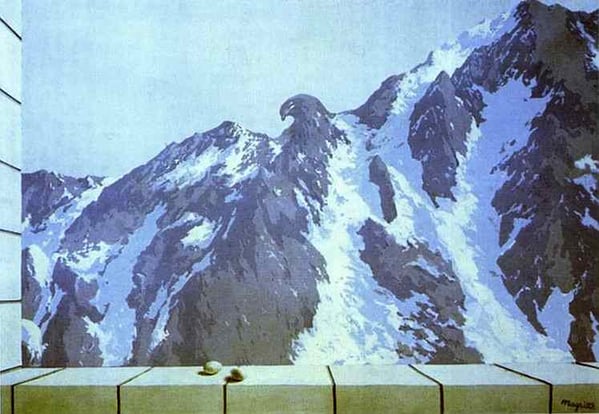
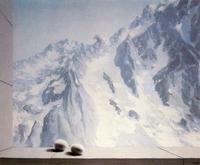
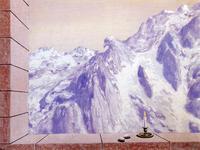
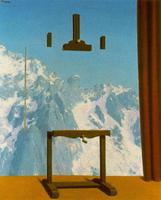
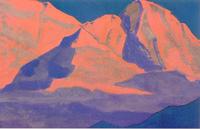
"The Domain of Arnheim" exemplifies René Magritte’s mastery of Surrealism during his Brussels pre-war and war years, a period when he refined his signature “magical realism” to challenge everyday perception. The painting takes its title from Edgar Allan Poe’s story of the same name, linking literature to visual art and inviting viewers to question the boundary between representation and reality.
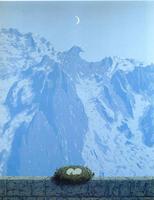
In the work, a monumental stone bird—perched on a mountain crest—appears both solid and spectral, while its body merges with the landscape. An immense egg rests in a nest that doubles as a rocky peak, creating a disquieting fusion of organic and geological forms. This deliberate incongruity—where familiar objects are displaced and rescaled—undermines rational space. The sky, rendered in flat, porcelain-like tones, reinforces the dreamlike stillness.
Magritte’s significance here lies in his subversion of scale and context. The egg and nest are not mere symbols but tools to destabilize the viewer’s reliance on visual logic. During the tense pre-war and war years in Brussels, such imagery resonated with a collective anxiety about the fragility of order. By borrowing Poe’s romantic “domain” and turning it into a silent, absurd monument, Magritte insists that the most profound mysteries dwell not in the fantastic but in the ordinary world—if only we dare to see it anew.