The Human Condition
Details
Expert analysis of Rene Magritte’s The Human Condition
Style: Surrealism · Genre: symbolic painting
Expert Analysis of "The Human Condition" by René Magritte
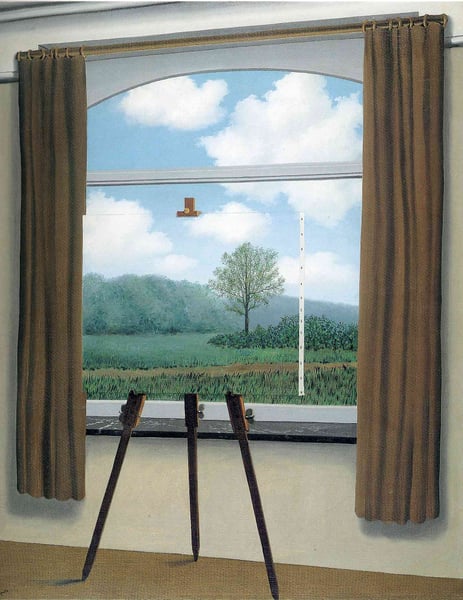
In this seminal work of Surrealism, painted during Magritte's Brussels pre-war and war years (1933–1939), the artist executes a symbolic meditation on perception and reality. The composition presents a window framing a landscape, before which stands an easel holding a canvas that depicts the identical view—seamlessly merging the painted scene with the actual background. This visual paradox is the essence of Magritte's inquiry into representation: the painting within the painting becomes a "veil" that both reveals and obscures the world beyond.
The work's significance lies in its subversion of traditional mimesis. Where earlier art sought to faithfully copy nature, Magritte exposes the artificiality of the mimetic act. By making the painted landscape exactly congruent with the "real" landscape, he forces the viewer to question where the frame of art ends and the frame of experience begins. This aligns perfectly with the Surrealist project of destabilizing rational categories—here, the boundary between object and image, truth and illusion.
Created in the tense atmosphere of pre-war Brussels and continuing through the Nazi occupation, the painting also reflects a period of existential uncertainty. The "human condition" of the title implies that our access to reality is always mediated, filtered through symbols, memories, and the very act of perception. Magritte's cool, precise technique—characteristic of his mature style—enhances the uncanny effect, making the deception all the more convincing and unsettling.
Within the Surrealist movement, this work stands as a definitive statement on the power of the image to question its own authority. It remains a touchstone for later theories of representation, influencing conceptual art and postmodern debates about the nature of the simulacrum.
Museum / Gallery
Visually similar
20 works with related composition and palette
The fair captive
Rene Magritte
The human condition
Rene Magritte
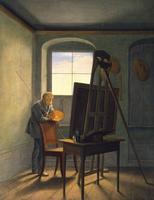
Caspar David Friedrich en su estudio
Georg Friedrich Kersting
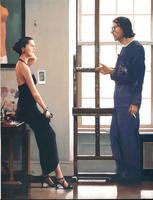
Artist and Model
Jack Vettriano
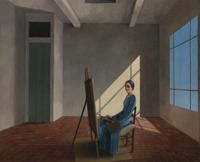
La femme peintre
Pierre Roy
Studio Interior
Dale Hickey
Models In The Studio II
Jack Vettriano
Interior with the Artist's Easel
Vilhelm Hammershoi
Token
Paul Nash
The Painter and the model
Antonio Bueno
Egry József, A Festő
Egry József
Self-Portrait
Horace Pippin
Portrait of the Artist as an Old Man
Eric Fischl
Chelsea Morning (self-portrait)
Jack Vettriano
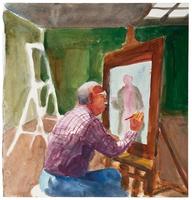
Self-Portrait Painting
Paul Wonner
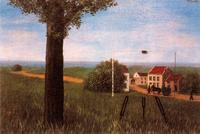
The fair captive
Rene Magritte
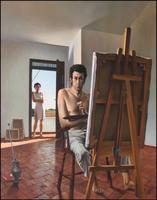
Self-Portrait
Jose Manuel Capuletti
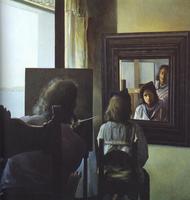
Dali from the Back Painting Gala from the Back Eternalized by Six Virtual Corneas Provisionally Reflected in Six Real Mirrors
Salvador Dali
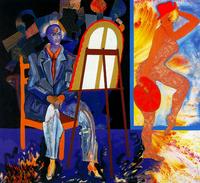
Shrine. Homage to Cézanne
Miriam Schapiro
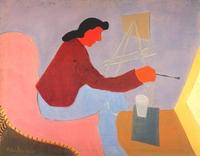
Female Painter
Milton Avery