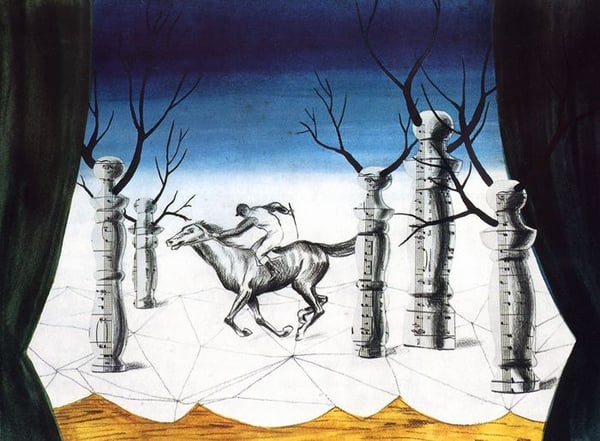
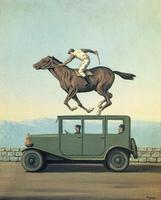
"The Lost Jockey" by René Magritte is a quintessential work from the artist’s Surrealist Paris years, a period when he fully embraced the movement’s core tenets. As a symbolic painting, it exemplifies Surrealism’s drive to disrupt rational reality through dreamlike, paradoxical imagery. The painting’s significance lies in how it embodies Magritte’s signature approach: juxtaposing familiar objects in impossible contexts to provoke a shift in perception. The jockey—a figure of motion and control—is rendered lost, suggesting a collapse of narrative logic. This aligns with Surrealism’s interest in the subconscious and the uncanny, where everyday elements are defamiliarized to reveal hidden psychological truths. Within the context of Magritte’s Paris years, the work marks his move away from the earlier, more chaotic forms of Surrealism toward a precise, almost academic style that heightens the disquieting effect of his symbolic puzzles. "The Lost Jockey" thus stands as a key example of how Magritte used clear, meticulous painting to challenge the boundary between reality and imagination, making it a cornerstone of his mature Surrealist vision.