
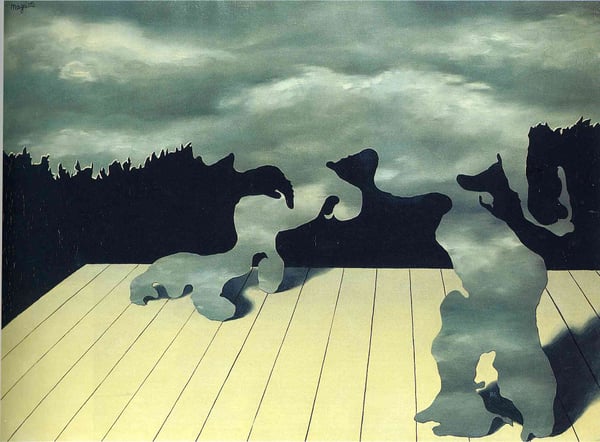
The muscles of the sky
Details
Expert analysis of Rene Magritte’s The muscles of the sky
Style: Surrealism · Genre: symbolic painting
Expert Analysis: "The Muscles of the Sky" by René Magritte (c. 1927–1930, Surrealist Paris period)
René Magritte’s The Muscles of the Sky exemplifies the core Surrealist mission to disrupt rational perception by fusing familiar natural elements with unexpected, bodily forms. Painted during his formative Paris years—when he fully embraced the movement’s tenets under the influence of André Breton and Giorgio de Chirico—this work is a quintessential example of Magritte’s “symbolic painting” genre, where objects are stripped of their usual functions and charged with psychological ambiguity.
Composition and Symbolism
The painting depicts a dramatic expanse of sky, but its clouds are transformed into organic, muscular bundles—taut, sinewy structures that resemble human biceps or pectoral muscles. These “muscles” stretch across the heavens, their contours both anthropomorphic and abstract. The sky itself is rendered in a crisp, illusionistic style, typical of Magritte’s “hand-painted dream” technique, which lends a clinical precision to the bizarre subject. The tension between the serene blue backdrop and the visceral, almost surgical anatomy creates a jarring cognitive dissonance: what should be airy and intangible becomes solid, fleshly, and oddly animate.
Significance within Surrealism
-
Subversion of scale and expectation – Magritte inverts the traditional hierarchy of the sky (vast, ethereal, divine) by grounding it in the corporeal. This aligns with Surrealism’s interest in Freudian ideas of the unconscious, where the body and its repressed desires intrude upon the rational world. The sky, often a symbol of transcendence, is here “muscular”—suggesting latent physical power, struggle, or even the viewer’s own embodied gaze.
-
Word-image play – The title itself is a surrealist pun: “muscles of the sky” literalizes a metaphorical phrase (like “muscles of the earth” for mountains) while undermining it. Magritte often used such linguistic disjunction (e.g., The Treachery of Images), forcing the viewer to question the link between language, image, and reality.
-
Paris-period maturation – While earlier works like The Menaced Assassin (1927) dealt with narrative shock, The Muscles of the Sky demonstrates Magritte’s shift toward a more philosophical, less overtly violent surrealism. It anticipates his later masterpieces (e.g., The Son of Man, The Empire of Light) by isolating a single metamorphosis and letting it radiate metaphysical unease.
Legacy
This painting remains significant for its radical redefinition of landscape. By making the sky a biological entity, Magritte collapses the boundary between nature and the human body—a theme that would later influence artists like Salvador Dalí (in his soft watches) and contemporary surrealist-inspired photographers. The Muscles of the Sky is not merely a visual oddity; it is a key to understanding how Surrealism used the ordinary to reveal the extraordinary, hidden structures of our unconscious reality.
Visually similar
20 works with related composition and palette
Black Place Green
Georgia O'Keeffe
Strange Landscape
Paule Vézelay
Lying Figure in Mirror
Francis Bacon
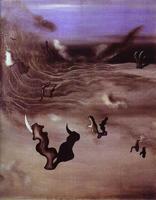
Wind
Yves Tanguy
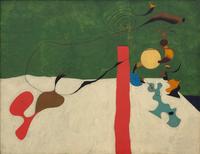
Still Life with Lamp
Joan Miro
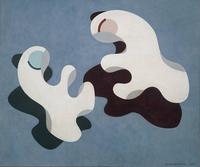
Dux et Comes I
Edward Wadsworth
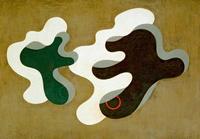
Dux et Comes IV
Edward Wadsworth
Baumlandschaft
Richard Oelze
Corte d'Appello
Enrico Donati
Untitled
Ivan Tovar
Couple with Clouds in Their Heads (Woman)
Salvador Dali
The Day After Yesterday
Desmond Morris
Don Quixote
Carloluigi Colombo
The Guardian of the Cycle
Desmond Morris
Untitled
Javad Hamidi
Gynandrologie
Jaroslav Serpan
Conversation
Edward Wadsworth
Two Lovers
Carloluigi Colombo
Figures in Front of a Metamorphosis
Joan Miro
Person Throwing a Stone at a Bird
Joan Miro