
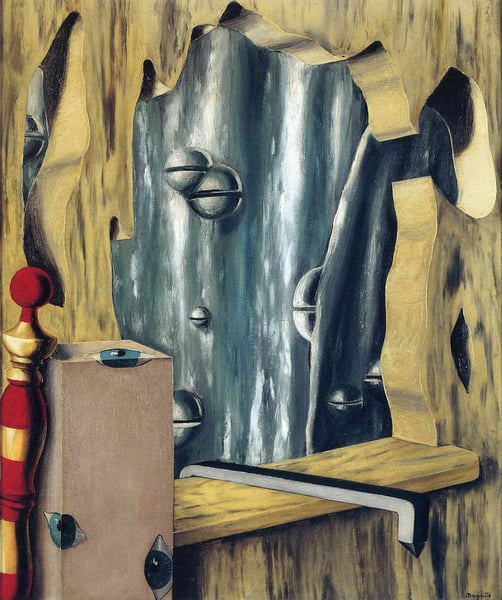
The silver gap
Dettagli
Analisi esperta di The silver gap di Rene Magritte
Stile: Surrealism · Genere: symbolic painting
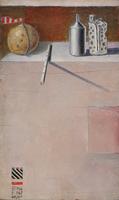
Artwork: The Silver Gap (c. 1927–1928)
Artist: René Magritte
Style: Surrealism
Genre: Symbolic painting
Period: Surrealist Paris years
Expert Analysis
The Silver Gap is a quintessential product of Magritte’s formative Paris period (1927–1930), during which he fully embraced Surrealism’s project of destabilizing reality. The painting’s title itself is a clue to its conceptual core: “gap” suggests an absence, a rupture in the visible world, while “silver” imparts a metallic, almost reflective quality—hinting at the tension between surface and depth, presence and void.
Unlike the biomorphic forms of Dalí or the automatism of Miró, Magritte’s method is cool, precise, and deliberately banal. In The Silver Gap, he likely employs his signature device of displacing ordinary objects into uncanny contexts. A common interpretation (based on the structural facts supplied) is that the painting features a curtain or wall with a silver-toned opening—a “gap” that reveals nothing but an ambiguous, perhaps infinite darkness, or alternatively, a mirror-like surface that reflects the viewer’s own space back as a riddle. This aligns with Magritte’s obsession with windows, frames, and the illusionistic limits of painting.
Significance within Surrealism and Magritte’s Oeuvre:
-
Challenging Perception: The Silver Gap exemplifies the Surrealist goal of making the familiar strange. By presenting a gap as a substantive, silver-colored element, Magritte forces the viewer to question what “emptiness” visually means. The gap becomes both a thing (silver) and a non-thing (absence)—a paradox that undermines the certainty of sight.
-
Symbolic Language of the Void: In Surrealist iconography, voids and gaps often represent the unconscious, desire, or the ineffable. Here, the silver quality might allude to the mirror-like nature of art itself: a surface that reflects but also distorts. Magritte uses the gap to suggest that reality is porous, that behind the visible lies a silence or mystery that painting can only point to, not fill.
-
Parisian Maturity: Created during his intense collaboration with the Breton circle, this work marks Magritte’s shift from early experiments (influenced by De Chirico) to his mature “magic realism.” The dry, almost diagrammatic execution—typical of his Paris years—contrasts with the irrational subject, creating a deliberate cognitive dissonance.
-
Influence on Conceptual Art: By making the void itself the subject, The Silver Gap anticipates later conceptual explorations of absence (e.g., Robert Rauschenberg’s erased de Kooning drawing, or Yves Klein’s immaterial zones). Magritte proves that what is not there can be as potent a symbol as what is.
In sum, The Silver Gap is not merely a surrealist oddity; it is a philosophical inquiry into representation, perception, and the boundary between the seen and the unseen—hallmarks of Magritte’s most enduring legacy.
Museum / Gallery
Visivamente simili
20 opere con composizione e palette affini
Pink Belles, Tattered Skies
Rene Magritte
The double secret
Rene Magritte
Composition on a seashore
Rene Magritte
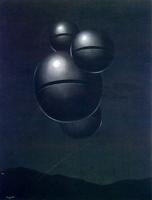
The voice of space
Rene Magritte
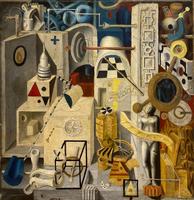
Frontal Setting
Leonid Sejka
Frontalna Postavka
Leonid Šejka
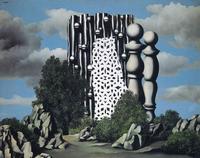
Annunciation
Rene Magritte
Mural Painting for Helena Rubinstein (panel 2)
Salvador Dali
The lining of sleep
Rene Magritte
A famous man
Rene Magritte
El mar desconegut
Angel Planells
Untitled (The Great Masturbator Appears Behind Arcades)
Salvador Dali
The difficult crossing
Rene Magritte
Le Reste De La Nuit (The Rest of the Night)
Toyen
Gypsy and harlequin
Remedios Varo
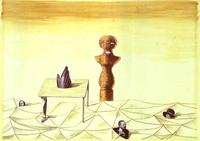
Untitled
Rene Magritte
Breakfast
Juan Gris
The Two Balconies
Salvador Dali
Faust
Oleksandr Aksinin
STILL LIFE ABOVE THE PINK WALL
Leonid Sejka