Expert Analysis of The Voice of Blood by René Magritte
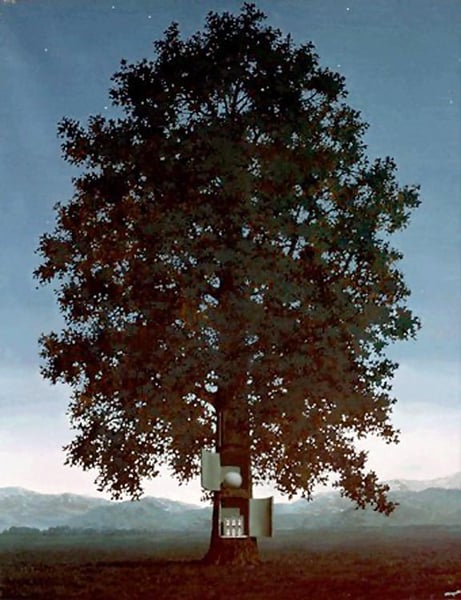
The Voice of Blood stands as a quintessential example of Magritte’s mature Surrealist period, revealing his mastery of symbolic painting through the unsettling fusion of the familiar and the impossible. Within the Surrealist movement, Magritte’s work is distinguished by its deadpan realism applied to dreamlike, often contradictory imagery—a technique that forces viewers to question the stability of perception and meaning.
In The Voice of Blood, the artist likely employs his characteristic juxtaposition of ordinary objects in extraordinary contexts, transforming a simple visual motif into a conduit for psychological and emotional resonance. The title itself suggests a tension between sound and substance, presence and absence. Magritte’s symbolic language here may explore themes of identity, memory, or the invisible forces that shape human experience—the “voice” of blood implying an ancestral or instinctual call that cannot be seen but is deeply felt.
What makes this artwork significant within Magritte’s oeuvre—and within Surrealism at large—is its ability to disrupt rational logic while maintaining a serene, almost academic precision. The mature period in which it was created marks a refinement of Magritte’s philosophical concerns, where objects are stripped of their assigned functions and recontextualized as signs charged with subconscious meaning. The Voice of Blood thus exemplifies how Surrealist symbolic painting can transform the mundane into a portal to the mysterious, inviting endless interpretation while resisting a single, definitive reading.