Expert analysis of Claude Monet’s Autumn Effect at Argenteuil
Style: Impressionism · Genre: landscape
Expert Analysis: "Autumn Effect at Argenteuil" by Claude Monet
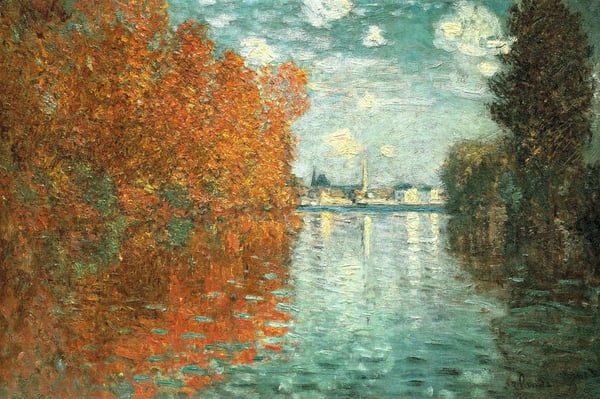
Claude Monet’s Autumn Effect at Argenteuil (c. 1873) stands as a quintessential example of Impressionism’s revolutionary approach to landscape painting. Painted during the artist’s most productive period in the suburban Seine town of Argenteuil, this work captures a fleeting moment of seasonal transition with extraordinary sensitivity to light and atmosphere.
Significance within Impressionism
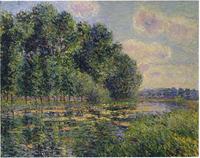
Monet’s primary innovation here lies in his treatment of the autumn scene not as a static description of trees and water, but as a unified field of vibrating color and reflected light. The term “effect” in the title is crucial: it signals Monet’s interest in the transient play of sunlight filtering through October foliage, rather than the literal rendering of a locale. By using broken, rapid brushstrokes and a palette dominated by golds, russets, and lavender shadows, he dissolves solid forms into shimmering patches of pigment. The water of the Seine becomes a mirror for the sky and leaves, blurring the boundary between substance and reflection—a hallmark of the Impressionist desire to capture the perceptual experience of a moment.
Why This Work Matters
Within the broader context of Monet’s Argenteuil series, Autumn Effect exemplifies his systematic study of how weather, season, and time of day alter a single subject. It foreshadows his later series on haystacks and Rouen Cathedral, where the motif is merely a vehicle for exploring light. Here, the autumn atmosphere is rendered not with browns or muted earth tones, but with a surprising vibrancy: the orange foliage is balanced by complementary blue-violet shadows, demonstrating Monet’s understanding of optical color mixing. The composition is deceptively simple—a diagonal row of poplars leading the eye along the riverbank—yet the painting’s true subject is the interplay of cool, hazy sky and warm, dappled ground.
In short, Autumn Effect at Argenteuil is significant because it encapsulates Impressionism’s core mission: to paint the air, the light, and the sensation of a season, rather than the objects themselves. Monet’s mastery of atmospheric color and his rejection of academic finish make this work a key document in the movement’s radical redefinition of landscape painting.
Museum / Gallery
Visually similar
20 works with related composition and palette
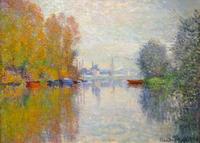
Autumn on the Seine at Argenteuil
Claude Monet
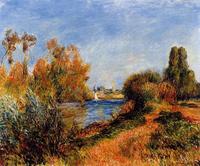
The Seine at Argenteuil
Pierre-Auguste Renoir

The Banks of The Seine in Autumn
Claude Monet
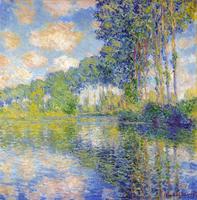
Poplars on the Epte
Claude Monet
The Small Arm of the Seine at Argenteuil
Claude Monet
River Landscape by Moret sur Loing
Alfred Sisley
By the Oise River
Gustave Loiseau
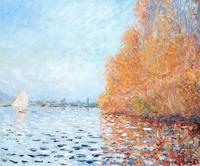
The Seine at Argenteuil
Claude Monet
River Bend in Normandy
Gustave Loiseau
The Normandy River
Gustave Loiseau
The Towpath at Granval
Claude Monet
By the Eure River in Autumn
Gustave Loiseau
Wood and Fields Near St Cyr Vadreuil
Gustave Loiseau
The Riverbanks
Georges Seurat
River's Edge
Georges Seurat
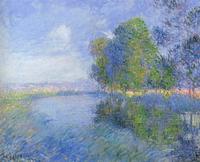
Trees in Bloom
Gustave Loiseau
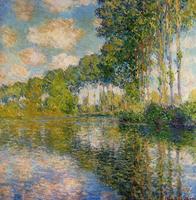
Poplars On The Banks Of The River Epte
Claude Monet
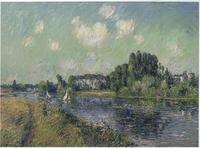
Sails on the Oise
Gustave Loiseau
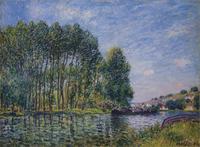
Spring on the Loing River
Alfred Sisley
By the Eure River in Summer
Gustave Loiseau