
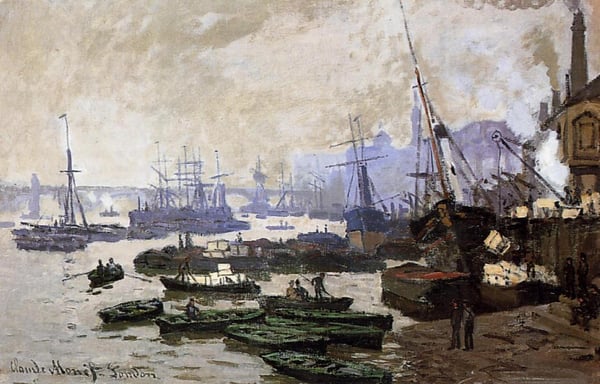
Expert analysis of Claude Monet’s Boats in the Pool of London
Style: Impressionism · Genre: cityscape
Expert Analysis: "Boats in the Pool of London" by Claude Monet
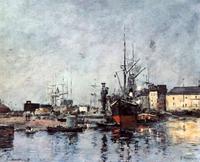
As a quintessential example of Impressionist cityscape painting, "Boats in the Pool of London" demonstrates Monet’s revolutionary approach to capturing the transient effects of light, atmosphere, and water—hallmarks that define the movement’s departure from academic realism. Although the scene depicts a recognizable urban subject—the Thames River bustling with commercial and leisure vessels—Monet subordinates topographical precision to the sensory experience of color and reflection. The “Pool of London” refers to a stretch of the Thames where docks and ships congest, yet Monet dissolves solid forms into dappled brushstrokes and soft, shifting hues. This treatment aligns with Impressionism’s core ambition: to record the fleeting moment, the impression of a scene as perceived under specific light and weather conditions.
What makes this work particularly significant within Impressionism is its synthesis of the genre’s two dominant pictorial interests: the modern cityscape and the study of water. Monet frequently painted series of the same subject (e.g., Rouen Cathedral, Haystacks) to document changing light; here, the river’s surface becomes a mirror that fractures and reforms color. The boats—mere silhouettes of masts and hulls—serve as compositional anchors, yet they are secondary to the pulsing reflections of sky and dock onto the water. The palette likely employs muted grays, blues, and warm ochres, typical of London’s hazy atmosphere, while the brushwork is energetic and sketch-like, prioritizing overall tone over detail.
In context, this painting underscores Monet’s contribution to the cityscape genre: he elevated everyday urban and industrial vistas—the Thames, trains, boulevards—to subjects worthy of fine art. By rendering the Pool of London not as a documentary record but as a poem of light, Monet expanded the boundaries of representation, influencing later movements from Post-Impressionism to Abstract Expressionism. The work remains a masterful testament to Impressionism’s enduring power to transform the ordinary into the extraordinary through perception itself.
Museum / Gallery
Visually similar
20 works with related composition and palette
The port of Rotterdam
Maximilien Luce
The Spanish quay in Rotterdam Sun
Eugene Boudin
The Port of London
Claude Monet
Bordeaux, the Port
Eugene Boudin
The Saint Sever Bridge at Rouen, Fog
Camille Pissarro
The port Portrieux
Eugene Boudin
Entrance to the Port of Le Havre
Eugene Boudin
Arkhangelsk
Konstantin Korovin
Le Havre. Avent Port.
Eugene Boudin
Camaret, Fishing Boats at Dock
Eugene Boudin
The Grand Dock at Le Havre
Claude Monet
Sunset, The Port of Rouen (Steamboats)
Camille Pissarro
The Isle of Wight
Berthe Morisot
The Docks, Rouen, Afternoon
Camille Pissarro
Outer harbour of Le Havre
Camille Pissarro
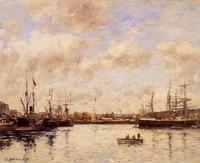
Le Havre
Eugene Boudin
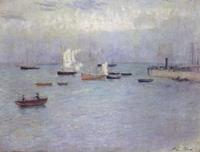
Poole Harbour
Philip Wilson Steer
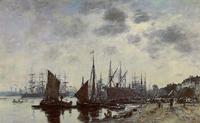
Bordeaux, Bacalan, View from the Quay
Eugene Boudin
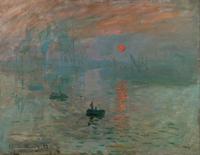
Impression, sunrise
Claude Monet
Untitled
Eugene Boudin