
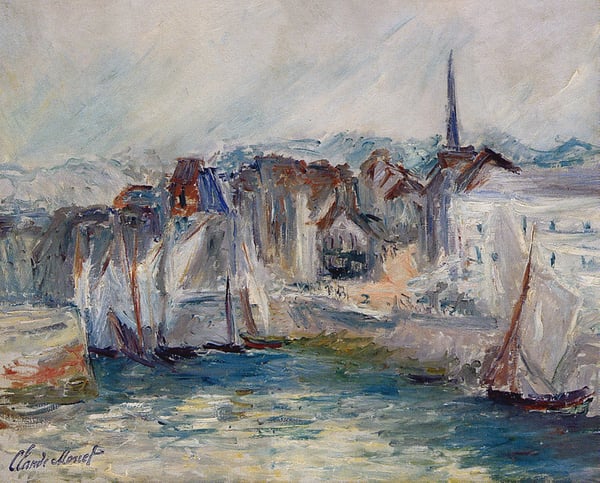
Expert analysis of Claude Monet’s Boats in the Port of Honfleur
Style: Impressionism · Genre: cityscape
Expert Analysis of "Boats in the Port of Honfleur" by Claude Monet
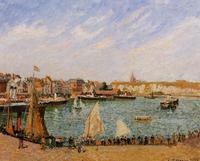
Claude Monet’s "Boats in the Port of Honfleur" stands as a quintessential example of Impressionism’s revolutionary approach to cityscape painting. Executed during a formative period when Monet was refining his technique of capturing transient light effects, this work transforms a familiar harbor view into a shimmering study of atmosphere and motion.
Significance within Impressionism:
The painting exemplifies the Impressionist break from academic convention. Instead of rendering precise outlines and static forms, Monet uses loose, rapid brushstrokes to evoke the play of light on water, masts, and quayside structures. The composition is less about the literal boats and more about the fleeting interplay of reflections, ripples, and sky. This aligns with the Impressionist goal of recording a single, ephemeral moment—likely dawn or dusk, when the harbor’s tones shift from cold to warm.
Handling of Light and Color:
Monet’s palette relies on broken color: short dabs of pure white, pale yellow, and lavender suggest sunlight dancing on the water’s surface, while complementary blues and oranges create optical vibration. The boats themselves are reduced to simplified dark silhouettes or softened by reflected hues, merging with their surroundings. The sky is not a flat backdrop but an active element, layered with clouds that diffuse the light unevenly.
Cityscape as Transient Scene:
Unlike traditional cityscapes that emphasize durable architecture, Monet’s Honfleur is a living, breathing locale defined by weather and tide. The port’s functional elements—the quay, the moored fishing boats, the distant rooftops—are rendered with equal attention to their reflected and refracted light, dissolving solid forms into atmosphere. This approach anticipates Monet’s later series (e.g., Rouen Cathedral), where the same subject is studied under varying conditions.
Legacy:
This painting demonstrates how Impressionism elevated the ordinary urban harbor to a subject of profound visual poetry. By prioritizing perception over documentation, Monet invites viewers to experience the port as a constantly changing sensory event—a signature achievement that continues to define the movement’s enduring appeal.
Visually similar
20 works with related composition and palette
Port at Dieppe in Fog
Gustave Loiseau
Harbour Scene, Dieppe
Paul Gauguin
Two Masted Schooner, Concarneau
Robert Henri
Port at Dieppe
Gustave Loiseau
Trouville, the Inner Port, Low tide
Eugene Boudin
The Port, Trouville
Eugene Boudin
Port of Dieppe
Gustave Loiseau
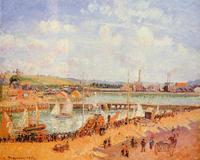
The Port of Dieppe, the Dunquesne and Berrigny Basins High Tide, Sunny Afternoon
Camille Pissarro
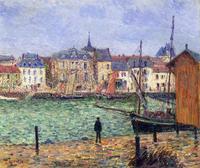
The Port of Pornic
Gustave Loiseau
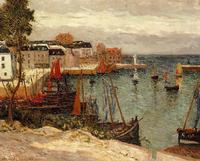
The Port of Sauzon
Maxime Maufra
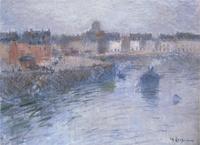
Port of Dieppe
Gustave Loiseau
L’Avant Port De Fecamp
Gustave Loiseau
Laundresses on the Banks of the Port of Trouville
Eugene Boudin
Port of Fecamp
Gustave Loiseau
Fishing Boats Leaving the Harbor, Le Havre
Claude Monet
The Port of Nice
Berthe Morisot
View of the Old Outer Harbor at Le Havre
Claude Monet
Port of Fecamp
Gustave Loiseau
Trouville, the Port
Eugene Boudin
Afternoon, Sun, the Inner Harbor, Dieppe
Camille Pissarro