Expert analysis of Claude Monet’s Breakup of Ice, Lavacourt, Grey Weather
Style: Impressionism · Genre: landscape
Expert Analysis: "Breakup of Ice, Lavacourt, Grey Weather" by Claude Monet
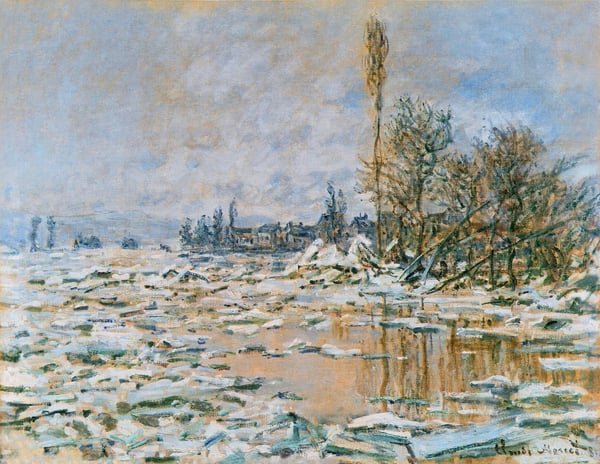
This work, painted in the Impressionist style, exemplifies Monet’s revolutionary approach to capturing transient atmospheric conditions. The landscape genre here is not a static depiction of nature but a study of flux—the titular “breakup of ice” signals a moment of seasonal change, rendered under “grey weather” that mutes contrast and diffuses light.
Significance within Impressionism:
- Emphasis on ephemeral light and weather: Monet prioritizes the fleeting effect of overcast skies on the frozen river, using muted greys, blues, and whites to create a hazy, unified atmosphere. This breaks from academic painting, which valued clear outlines and stable compositions.
- Loose, visible brushwork: Quick, broken strokes suggest the texture of melting ice and water, inviting the viewer to experience the scene’s movement rather than a detailed topography.
- Serial exploration: Although supplied facts do not confirm a series, Monet was known for painting multiple canvases of the same subject under varying conditions—this work fits that method, demonstrating how a single motif (the Seine at Lavacourt) yields entirely different emotional and visual effects depending on weather and time.
Significance within its period (1870s–1880s):
- Challenge to traditional landscape painting: By choosing a “non-picturesque” subject—ice breakup on a grey day—Monet elevates ordinary, transitional moments to art. This defiantly rejects the Salon’s preference for idealized, dramatic scenery.
- Precursor to modern abstraction: The reduced palette and focus on atmospheric unity push the landscape toward a nearly abstract field of tones, where subject matter is subordinate to sensory experience.
In summary, this painting is a masterful distillation of Impressionist principles: it finds beauty in impermanence, prioritizes perception over objects, and redefines landscape as a record of light and mood rather than a topographical document.
Visually similar
20 works with related composition and palette
The Break-up of the Ice
Claude Monet
Breakup of Ice
Claude Monet
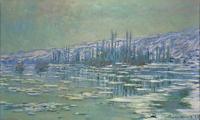
Ice Floes on Siene
Claude Monet
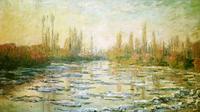
The Ice Floes
Claude Monet
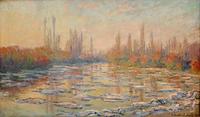
Floating Ice on the Seine 02
Claude Monet
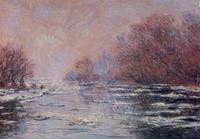
River Thawing near Vetheuil
Claude Monet
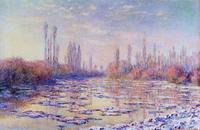
Floating Ice on the Seine
Claude Monet
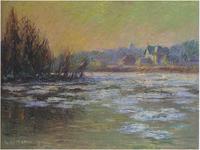
Ice on the Oise River
Gustave Loiseau
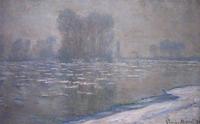
Ice Floes, Misty Morning
Claude Monet
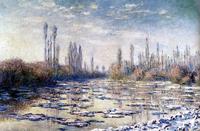
Floating Ice Near Vetheuil
Claude Monet
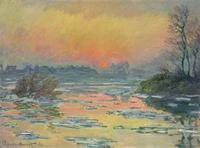
Sunset on the Seine in Winter
Claude Monet
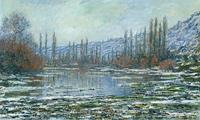
The Thaw at Vetheuil
Claude Monet
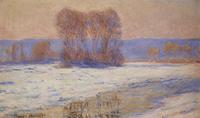
The Seine at Bennecourt, Winter
Claude Monet
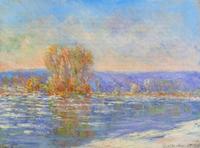
Floating Ice near Bennecourt
Claude Monet
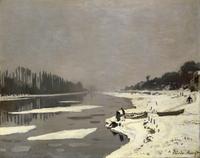
Ice Floes on the Seine at Bougival
Claude Monet
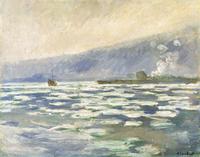
Ice, Lock Port Villez
Claude Monet
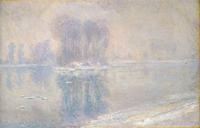
Ice on the Siene at Bennecourt
Claude Monet
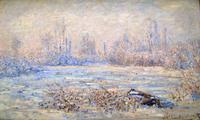
Frost near Vetheuil
Claude Monet
The Effect of Sunlight on the Banks of the Loing
Francis Picabia
The Seine at Argenteuil
Claude Monet