
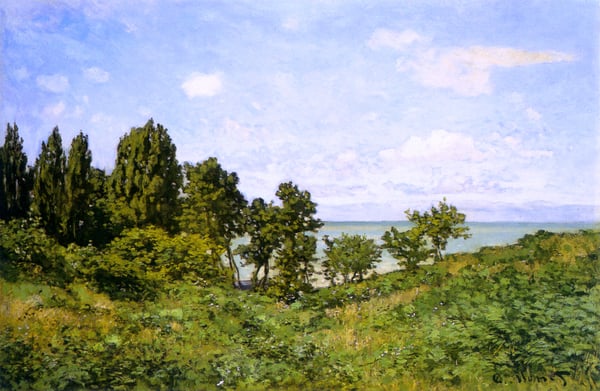
Expert analysis of Claude Monet’s By the Sea
Style: Realism · Genre: landscape
Expert Art Historical Analysis: "By the Sea" by Claude Monet
Claude Monet’s “By the Sea” (c. 1865–1866) is a compelling example of his early engagement with Realism, a style that demanded truthful, unidealized representation of everyday scenes. While Monet would later become the defining figure of Impressionism, this work belongs to his formative period when he studied under Realist painters like Charles Gleyre and was deeply influenced by the gritty naturalism of Gustave Courbet and the Barbizon school.
Significance within Realism
The painting depicts a coastal landscape—likely the Normandy shore near Le Havre or Sainte-Adresse—without the dramatic or sentimental trappings typical of Romantic seascapes. Instead, Monet focuses on the objective observation of light, weather, and the texture of sand, sea, and sky. The composition is straightforward: a broad horizon line divides the canvas into equal parts sky and water, while a low, muted palette of grays, blues, and earthy browns conveys the overcast atmosphere and the raw, unromanticized chill of the northern coast.
Monet’s brushwork here is relatively tight and controlled, emphasizing precise topographical details—the ripples in the water, the wet sand, the distant fishing boats—consistent with Realism’s goal of documentary truth. Yet even in these early strokes, one can sense his fascination with transient effects: the subtle gradations of cloud cover and the reflection of light on the sea’s surface.
What Makes It Significant
- A bridge between Realism and Impressionism: “By the Sea” demonstrates Monet’s commitment to painting en plein air (outdoors), a practice that would become central to Impressionism. The work captures a specific moment in time, but it still adheres to Realism’s structured tonal values and clear outlines.
- Rejection of academic conventions: Rather than idealizing the landscape or imposing a narrative, Monet presents the sea as a subject in itself—a "portrait" of a particular place and weather condition. This anti-heroic approach was radical for the mid-1860s, placing him squarely in the Realist camp.
- Evidence of Monet’s evolution: Art historians often point to this painting as a key precursor to his later Impressionist masterpieces like Impression, Sunrise (1872). The handling of water and sky here is more empirical than expressive, but the seeds of his interest in light’s ephemeral effects are unmistakable.
In sum, “By the Sea” stands as a testament to Monet’s Realist foundation—a disciplined, naturalistic study that grounds his revolutionary Impressionist innovations in the hard-won clarity of observation. It reminds us that even the most radical innovators first master the rules before breaking them.
Visually similar
20 works with related composition and palette
A part of Groettes, Pontoise, Gray Weather
Camille Pissarro
Shinnecock Hills, Peconic Bay
William Merritt Chase
Road Through a Field of Wildflowers
Granville Redmond
The Bay of Saint-Tropez
Maxime Maufra
Dogs running through a field
Paul Gauguin
East Hampton
Childe Hassam
Landscape near Villerville
Charles-Francois Daubigny
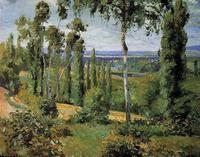
The Countryside in the Vicinity of Conflans Saint Honorine
Camille Pissarro
Landscape, Sunset
Frederick George Cotman
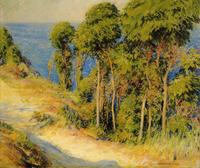
Trees Along the Coast (Road to the Sea)
Joseph DeCamp
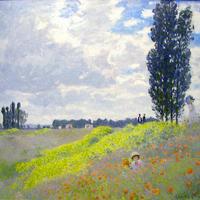
Walk in the Meadows at Argenteuil
Claude Monet
Resting in the woods Pontoise
Camille Pissarro
Landscape with Strollers Relaxing under the Trees
Camille Pissarro
Washerwomen on the Riverbank
Charles-Francois Daubigny
Yerres, the Lawn in the Park, Seen from a Path
Gustave Caillebotte
View of the Sea from Villerville
Gustave Caillebotte
Quarries at Pontoise
Paul Gauguin
Landscape with a Cowherd
Camille Pissarro

Berry Picker
T. C. Steele
Wheatfield by the Sea
Nathaniel Hone the Younger