
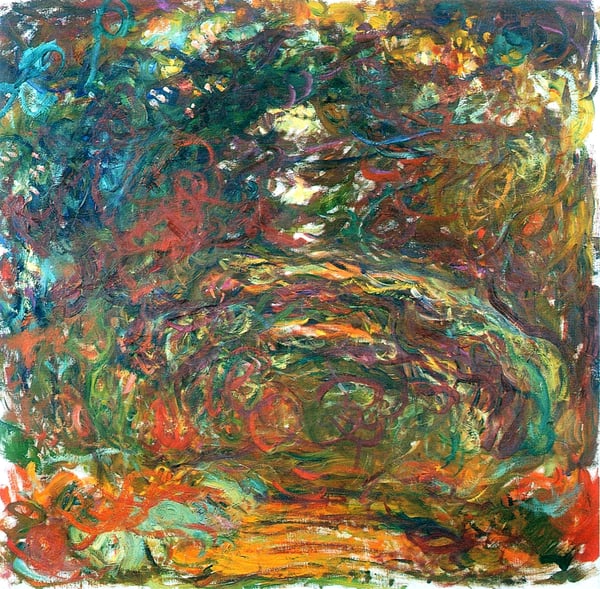
Expertenanalyse zu Claude Monets Path under the Rose Arches, Giverny
Stil: Impressionism · Genre: landscape
Expert Analysis of Claude Monet’s Path under the Rose Arches, Giverny
Executed in the late phase of Claude Monet’s career, Path under the Rose Arches, Giverny exemplifies the culmination of Impressionist principles while also foreshadowing the painter’s later, almost abstract handling of light and form. Though the supplied facts identify the work simply as an Impressionist landscape, its significance lies in how Monet transforms a specific, personal locale—his own garden at Giverny—into a universal meditation on perception and atmosphere.
Significance within Impressionism
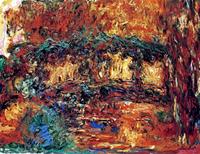
- Capturing Fleeting Light and Atmosphere: The painting epitomizes the Impressionist obsession with plein air immediacy. The rose arches form a lattice of color that breaks down into dappled patches of pink, green, and violet, while the pathway dissolves into shifting highlights and shadows. Monet does not depict a fixed botanical record; instead he renders the experience of walking under the arches as sunlight filters through petals and leaves.
- En plein air and Subjective Vision: Created outdoors (as was Monet’s habit in his Giverny series), the work embodies the core Impressionist tenet that an artwork should capture a “moment” in time. The soft, broken brushwork—rapid dabs of pure color—conveys the optical vibration of light on foliage, forcing the viewer’s eye to optically mix the hues. This technique, pioneered by Monet, prioritizes perceptual truth over mimetic detail.
Place in Monet’s Giverny Period
- Personal Subject as Artistic Laboratory: By the 1890s, Monet had retreated to Giverny, where he transformed his garden into a living canvas. Path under the Rose Arches is part of his obsessive series—like his Water Lilies or Haystacks—in which he endlessly reexamined the same motif under varying conditions of light and season. Here the rose-covered trellises become a vehicle for exploring how color and texture shift from dawn to midday, from dry to damp air.
- Bridge to Abstraction: The horizontal path and vertical arches create a rhythmic, almost decorative pattern that flattens pictorial space. This tension between deep space (the receding path) and surface pattern (the dense, textured strokes) anticipates the all-over compositions of his late water-lily paintings, where subject dissolves entirely into light. Thus Path under the Rose Arches is not merely a pretty landscape but a crucial step toward 20th-century abstract expressionism.
Conclusion
Monet’s painting is significant because it distills the Impressionist revolution into a single, intimate view: the artist’s own garden transformed into a laboratory of perception. By rendering a humble path through rose arches with such radical attention to fleeting color and atmosphere, Monet demonstrates that Impressionism’s true subject is not what we see, but how we see—an idea that would profoundly influence modern art.
Genre
Stil
Visuell ähnlich
20 Werke mit ähnlicher Komposition und Farbpalette
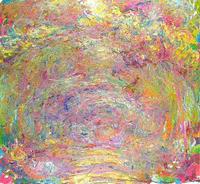
Path under the Rose Trellises
Claude Monet
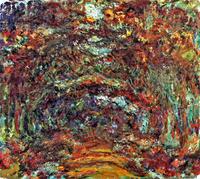
The Rose Path, Giverny
Claude Monet
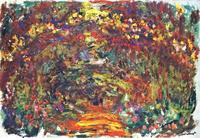
Path under the Rose Trellises, Giverny
Claude Monet
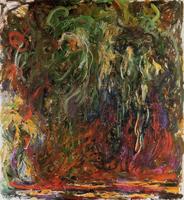
Weeping Willow, Giverny
Claude Monet
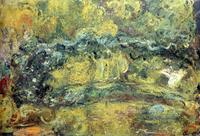
The Japanis Bridge (Footbridge over the Water-Lily Pond)
Claude Monet
Water Lilies (right half)
Claude Monet
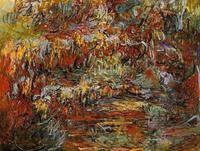
The Japanese Bridge 8
Claude Monet
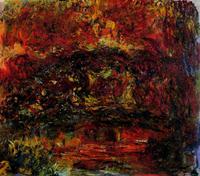
The Japanese Bridge
Claude Monet
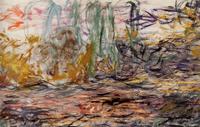
Water Lilies (left half)
Claude Monet
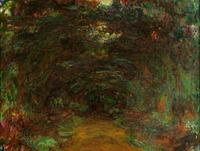
Path under the Rose Trellises, Giverny
Claude Monet
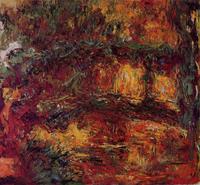
The Japanese Bridge at Giverny
Claude Monet
The House at Giverny Viewed from the Rose Garden
Claude Monet
The Japanese Bridge 4
Claude Monet
Earth’s Creation 1
Emily Kame Kngwarreye
Tilleul
Joan Mitchell
Landscape
Oleg Holosiy
Earth’s Creation
Emily Kame Kngwarreye
Tree No.6
Jeremy Henderson
The Japanese Bridge
Claude Monet
The Japanese Bridge 7
Claude Monet