
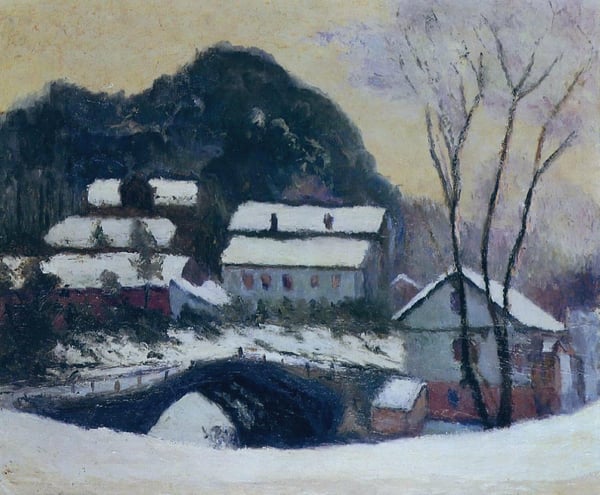
Analisi esperta di Sandviken, Norway di Claude Monet
Stile: Impressionism · Genere: cityscape
Expert Analysis: "Sandviken, Norway" by Claude Monet
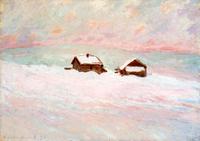
Claude Monet’s Sandviken, Norway (1895) stands as a compelling testament to the Impressionist pursuit of capturing transient atmospheric effects, while also marking a pivotal moment in the artist’s personal evolution. Painted during a productive winter journey to Norway, this cityscape reveals Monet’s fascination with how light and weather transform a familiar scene—here, the small coastal village of Sandviken near Bergen.
Significance within Impressionism and Monet’s Oeuvre:
-
Mastery of Snow and Northern Light – Monet was drawn to the challenges of painting snow, a subject he explored in earlier works like The Magpie. In Sandviken, Norway, he pushes further, using a palette of muted violets, soft blues, and pale golds to render the crisp, diffused light of a Nordic winter. The snow-covered roofs and frozen water are not white but shimmer with reflections of sky and atmosphere—a quintessential Impressionist approach that prioritizes perception over local color.
-
Bridge to the Series Paintings – This work belongs to a group of about 20 canvases Monet executed during his two-month stay in Norway. Like his later Haystacks and Rouen Cathedral series, these Norwegian views repeat a motif under varying conditions (morning, midday, dusk). Sandviken, Norway specifically captures a moment of delicate sunlight breaking through clouds, demonstrating Monet’s systematic study of how light alters form and mood—a practice that would define his most famous series.
-
Stillness vs. Vibrancy – While Impressionism is often associated with bustling Parisian streets, Sandviken achieves a quiet monumentality. The composition is deceptively simple: a row of houses, a snowy hill, a calm fjord. Yet the loose, broken brushstrokes animate the surface, suggesting the shimmer of snow and the subtle movement of air. This tension between stillness and pictorial energy highlights Monet’s skill in making the ordinary extraordinary.
-
Cultural and Artistic Context – Monet’s Norwegian journey was part of a broader European fascination with Scandinavian landscapes. By applying Impressionist techniques to a distinctly northern scene—with its long shadows, low angle of winter sun, and pristine whiteness—he demonstrated that the movement’s principles were universal. The painting thus expanded the boundaries of Impressionist subject matter beyond France, proving that atmosphere, not locale, was the true subject.
In summary, Sandviken, Norway is significant as a luminous example of Monet’s winter palette, a precursor to his serial investigations, and a bold assertion that Impressionism could render the unique light of any corner of the world. It remains a quieter but essential chapter in Monet’s lifelong quest to “paint the air.”
Genere
Stile
Visivamente simili
20 opere con composizione e palette affini
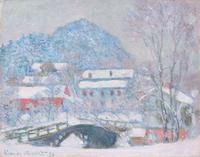
Norway, Sandviken Village in the Snow
Claude Monet
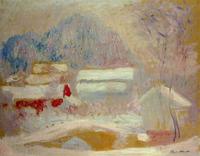
Norwegian Landscape, Sandviken
Claude Monet
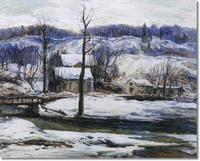
The Mill In Winter
Charles Reiffel
The White Mantle
Willard Metcalf
Landscape by a Brook
Bertalan Por
Country House in Winter
John Henry Twachtman
La Ferme De Bonnevaux
Gustave Courbet
The Stream in Labastide du Vert
Henri Martin
Twachtman's Home, Avondale, Ohio
John Henry Twachtman
Misty Day in March
Ernest Lawson
An Early Winter
John Henry Twachtman
Snow Scene at Utica
John Henry Twachtman
Labastide du Vert Village
Henri Martin
Town Street
Abraham Manievich
January Sunshine
Fern Coppedge
Snowy Landscape (aka Frost)
Berthe Morisot
Winter Landscape
John Henry Twachtman
Snow Scene
John Henry Twachtman
Houses in the Snow, Norway
Claude Monet
Landscape with House
Gustave Loiseau