
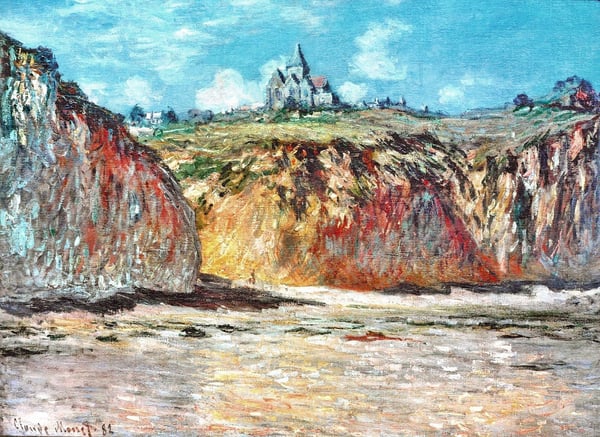
The Church at Varengeville 02
Details
Expert analysis of Claude Monet’s The Church at Varengeville 02
Style: Impressionism · Genre: landscape
Expert Analysis: The Church at Varengeville 02 by Claude Monet
Claude Monet’s The Church at Varengeville 02 stands as a quintessential example of Impressionism’s radical shift from documenting objects to capturing perceptual experience. Painted in the early 1880s during a period when Monet was systematically exploring series—a practice that would later culminate in his Haystacks and Rouen Cathedral—this work demonstrates his commitment to rendering the fleeting effects of light and atmosphere on a single motif.
Significance within Impressionism
-
Light over structure: Monet dissolves the solid architecture of the church into a vibrant tapestry of broken brushstrokes and shifting color. The building becomes a prism for sunlight, with shadows rendered in deep blues and purples, and sunlit surfaces in warm ochres and pinks. This approach epitomizes the Impressionist belief that the true subject of a painting is not the object itself but the transient interplay of light, color, and atmosphere.
-
En plein air spontaneity: Painted directly on location in the coastal village of Varengeville-sur-Mer in Normandy, the work captures a specific moment—likely a late afternoon view when the sun casts long diagonal shadows across the church’s facade. The rapid, unblended dabs of paint convey the immediacy of the artist’s optical sensation, a hallmark of Monet’s mature technique.
-
Series as exploration: This canvas is one of several studies of the same church (often distinguished by numbers like “02”), each taken from a slightly different viewpoint or at a different time of day. Monet’s method of painting the same subject repeatedly was revolutionary: it demonstrated that reality is not fixed but changes with every passing minute. The Church at Varengeville 02 thus serves as a precursor to his later, more famous serial works, showing his growing fascination with how a single structure could yield an infinite range of visual possibilities.
Artistic Execution
Monet employs a high-keyed palette typical of Impressionism, with white, pale blue, and soft green infiltrating the sky and ground. The church spire rises in a patchwork of pale rose and violet, while the surrounding foliage and sky are handled with swift, calligraphic strokes that suggest movement. The road curving toward the church leads the eye into the composition, yet the painting refuses a clear focal point—the whole surface vibrates with equal intensity, mirroring the way peripheral vision registers light.
Legacy
The Church at Varengeville 02 encapsulates the Impressionist revolution: it sacrifices architectural precision for atmospheric truth, prioritizing the artist’s sensory response over topographical accuracy. In doing so, Monet not only redefined landscape painting but also paved the way for modernist abstraction, where the act of seeing itself became the painting’s central drama. This work is a vital link between Monet’s early experiments and his monumental series of the 1890s—proof that even a modest church could become a vehicle for profound artistic insight.
Visually similar
20 works with related composition and palette
The Church at Varengeville
Claude Monet
Church at Varengeville, Morning
Claude Monet
Low Tide at Pourville 02
Claude Monet
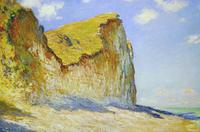
Cliffs near Pourville
Claude Monet
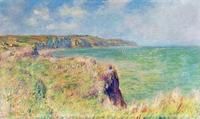
Edge of the Cliff at Pourville
Claude Monet
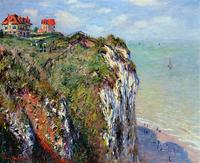
Cliff at Dieppe
Claude Monet
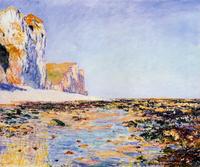
Beach and Cliffs at Pourville, Morning Effect
Claude Monet
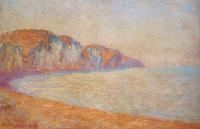
Cliff at Pourville in the Morning
Claude Monet
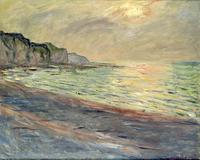
Pourville, Sunset
Claude Monet
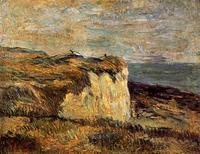
Cliff near Dieppe
Paul Gauguin
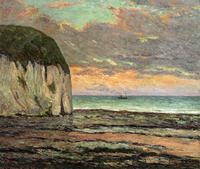
Sunset
Maxime Maufra
Cliffs at Petit Dalles
Camille Pissarro
Low Tide at Varengeville
Claude Monet
Beach at Dieppe
Konstantin Korovin
Calm Weather, Fecamp
Claude Monet
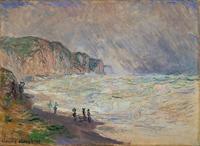
Heavy Sea at Pourville
Claude Monet
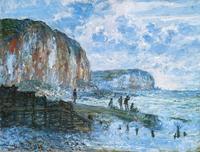
Cliffs of Les Petites-Dalles
Claude Monet
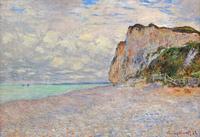
Cliffs near Dieppe
Claude Monet
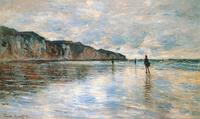
Low Tide at Pourville
Claude Monet
Cliff at Pourville 2
Claude Monet