
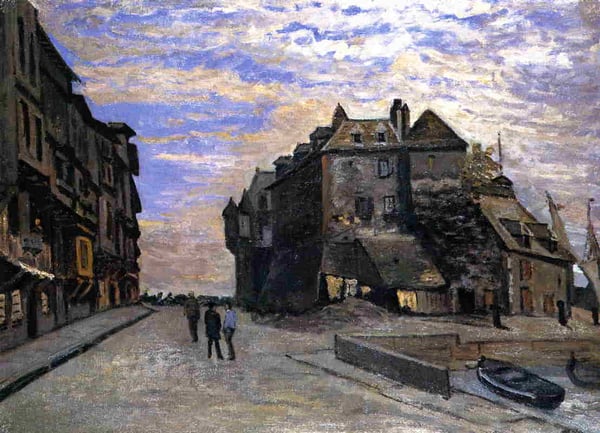
Analisi esperta di The Lieutenancy at Honfleur di Claude Monet
Stile: Impressionism · Genere: cityscape
Expert Analysis: "The Lieutenancy at Honfleur" by Claude Monet
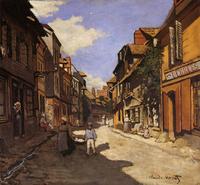
As an early cityscape from Claude Monet’s formative years, The Lieutenancy at Honfleur (c. 1864) is significant for its role in shaping the core principles of Impressionism. Painted when Monet was still developing his distinctive style, this work already demonstrates a decisive break from the rigid, detail-oriented traditions of academic art.
Significance within Impressionism:
-
Prelude to Plein Air and Light Studies
The painting captures a specific moment in time, emphasizing the play of natural light on the old Lieutenancy building at Honfleur’s harbor. Monet’s loose, visible brushstrokes suggest atmosphere and transient weather conditions—hallmarks of the plein air approach that Impressionists would later champion. -
Simplification of Form and Color
Instead of delineating every architectural element, Monet uses broad patches of color to convey the structure’s mass and the reflections on the water. This prefigures his mature Impressionist technique, where color and light take precedence over precise outline. -
Honfleur as a Crucible for Impressionism
Honfleur’s harbor, with its shifting light and water refractions, was a key location for Monet and his contemporaries (e.g., Jongkind, Boudin). This work exemplifies how the locale inspired a new way of seeing—urban scenes rendered with the spontaneous freshness that would define the first Impressionist exhibitions.
In The Lieutenancy at Honfleur, we witness Monet’s transition from realist observation to the radical colorism and atmospheric vibration that would soon revolutionize painting. Its significance lies in its early embodiment of Impressionist ideals: capturing the fleeting, the ordinary, and the luminous.
Visivamente simili
20 opere con composizione e palette affini
Construction Site at Saint Mammes
Alfred Sisley
Rue des Saules. Montmartre
Paul Cezanne
Street in Marly
Alfred Sisley
Harbour Scene, Dieppe
Paul Gauguin
Twilight
Maxime Maufra
Street in Moret Sur Loing
Alfred Sisley
The Embankment of Lagny under Flood Water
Maxime Maufra
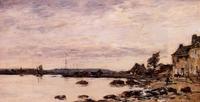
Breton Shoreline
Eugene Boudin
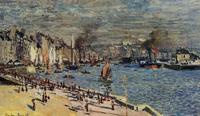
View of the Old Outer Harbor at Le Havre
Claude Monet
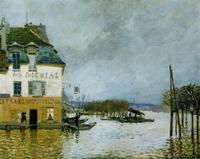
Flood at Port Marly
Alfred Sisley
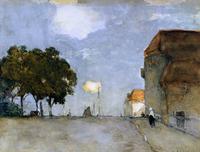
City view
Johan Hendrik Weissenbruch
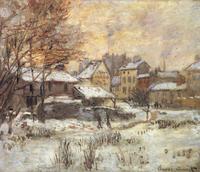
Snow Effect with Setting Sun
Claude Monet
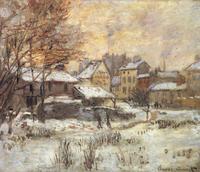
Snow Effect with Setting Sun
Claude Monet
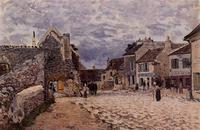
Village Street Grey Weather
Alfred Sisley
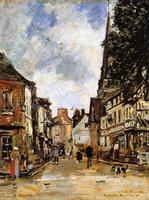
Fervaques, a Village Street
Eugene Boudin
Saint Mammès in Morning
Alfred Sisley
The arrival of the mail boat, Christiansø (study)
Edvard Weie
Saint Mammes
Alfred Sisley
Street Snow Effect
Camille Pissarro
The La Rue Bavolle at Honfleur 2
Claude Monet