
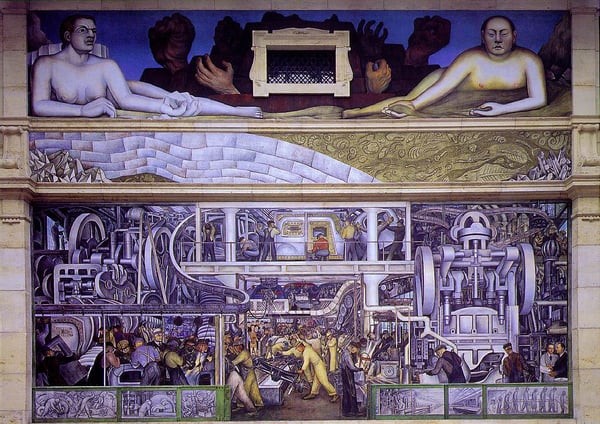
Analisi esperta di Detroit Industry, South Wall di Diego Rivera
Stile: Muralism · Genere: genre painting
Expert Analysis of Detroit Industry, South Wall by Diego Rivera
Diego Rivera’s Detroit Industry, South Wall (1932–33) is a cornerstone of the Muralism movement and a definitive example of genre painting elevated to monumental public art. This work, part of the larger Detroit Industry fresco cycle at the Detroit Institute of Arts, holds profound significance for its synthesis of modernist technique, political ideology, and celebratory depiction of industrial labor.
Significance Within Muralism and Its Period
As a product of the Mexican Muralist Renaissance, Rivera brought his signature indigenista and social realist ethos to the heart of American industry. The South Wall focuses on the assembly of an automobile’s engine and chassis—a genre scene of everyday work. However, Rivera transforms this mundane industrial process into a heroic, almost mythological narrative. The composition is dense and rhythmic: dozens of workers—predominantly anonymous, multi-ethnic figures—coordinate in a synchronized, ballet-like flow along the production line. Their muscular bodies and focused expressions echo the monumental figures of Renaissance frescoes, but here they are modern laborers, not saints or gods.
What makes this work significant is its radical reframing of the assembly line as a site of collective dignity and power, rather than alienating toil. Rivera depicts machinery and human hands in perfect synergy: steel beams, conveyor belts, and drills are rendered with geometric precision, while the workers’ faces convey pride and grit. This duality—celebrating technological progress while humanizing its agents—was a bold statement during the Great Depression, when labor struggles and mechanization were hotly debated. The mural thus breaks from purely decorative or allegorical muralism, instead grounding its visual language in observable, contemporary life—a hallmark of genre painting.
Stylistically, the South Wall exemplifies Muralism’s commitment to accessible public art: it is large-scale, narrative, and didactic without being propagandistic. Rivera employs a limited but vibrant palette of grays, blues, warm earth tones, and white highlights to unify the scene, while his careful modeling of form owes as much to Italian Renaissance frescoes (particularly Giotto and Masaccio) as to Mexican folk traditions. The result is a work that bridges high art and popular culture, industrial realism and timeless classicism.
Finally, the mural’s significance lies in its cross-cultural impact. By bringing Mexican Muralism to the United States, Rivera influenced a generation of American artists to embrace murals as tools for social commentary. Detroit Industry, South Wall remains a masterful testament to art’s ability to dignify the ordinary, making visible the often-invisible hands that build modern civilization.
Museum / Gallery
Genere
Stile
Visivamente simili
20 opere con composizione e palette affini
Detroit Industry, North Wall
Diego Rivera
The World of Today and Tomorrow
Diego Rivera
Allegory of California
Diego Rivera
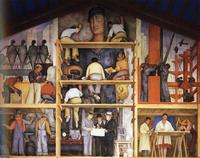
The Making of a Fresco, Showing The Building of a City
Diego Rivera
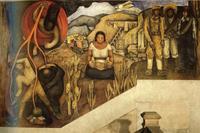
The Mechanization ofThe Country
Diego Rivera
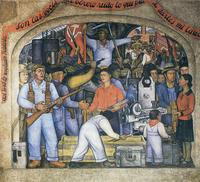
The Arsenal
Diego Rivera
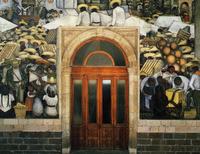
The Market
Diego Rivera
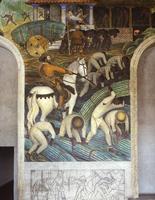
Sugar Plantation, Tealtenango, Morelos and Indian Slaves in the Gold Mines
Diego Rivera
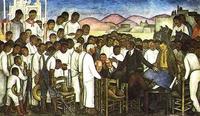
Partition of the Land.
Diego Rivera
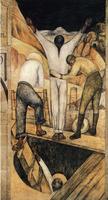
Exit from the Mine
Diego Rivera
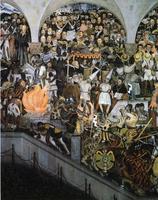
The History of Mexico
Diego Rivera
Tehuana Women
Diego Rivera
The History of Mexico
Diego Rivera
The Huastec Civilisation
Diego Rivera
Zapata's Horse
Diego Rivera
The Ancient Indian World
Diego Rivera

The New School
Diego Rivera
The History of Medicine in Mexico: The People’s Demand for Better Health
Diego Rivera
The Papermakers
Diego Rivera
Death of the Capitalist
Diego Rivera