Analisi esperta di At the Cafe des Ambassadeurs di Edgar Degas
Stile: Impressionism · Genere: genre painting
Expert Analysis: "At the Cafe des Ambassadeurs" by Edgar Degas
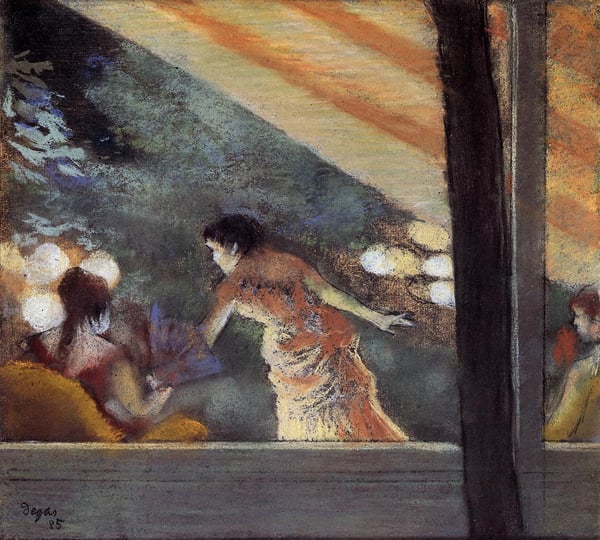
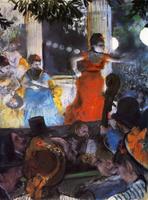
Edgar Degas’s At the Cafe des Ambassadeurs exemplifies the Impressionist fascination with modern urban leisure while diverging from the movement’s typical emphasis on natural light. Painted in the mid-1870s, the work captures the vibrant café-concert culture of late 19th-century Paris—a subject Degas returned to obsessively.
Significance within Impressionism and Genre Painting:
-
Reimagining the Scene: Unlike Monet or Renoir’s sun-dappled landscapes, Degas focuses on artificial illumination. The gaslights of the Café des Ambassadeurs create sharp contrasts and a stage-like glow, emphasizing the performative nature of public entertainment. This treatment of artificial light was radical for its time, prefiguring later explorations of nightlife and spectacle.
-
Candid Observation and Cropping: Degas adopts a high, oblique viewpoint—as if from a balcony or neighboring table—unexpectedly cropping figures at the edges. The singer, possibly Thérésa, is rendered in profile, her gesture frozen mid-performance. This compositional technique, influenced by photography and Japanese ukiyo-e prints, gives the scene a spontaneous, snapshot-like immediacy, reinforcing the Impressionist goal of capturing transient moments.
-
Social Commentary: The painting is a genre scene but one laden with psychological tension. The audience members are often isolated, absorbed in their own experiences, suggesting the anonymity and fragmentation of modern city life. Degas portrays the café-concert not as a simplistic pleasure palace but as a site of complex social dynamics, anticipating the urban realism of later artists like Toulouse-Lautrec.
-
Technical Innovation: Degas uses pastel over monotype for this work, a hybrid medium that allows both soft, velvety tones (for the hazy audience) and sharp, incisive lines (for the performer’s silhouette). This interplay of texture and edge was groundbreaking, demonstrating how Impressionist methods could be adapted to interior, nocturnal settings.
Ultimately, At the Cafe des Ambassadeurs is significant because it expands Impressionist subject matter beyond the countryside, proving that modern urban spectacle—with its synthetic light, fleeting gestures, and layered social codes—was equally worthy of the movement’s formal experiments. Degas’s cool, unsentimental eye made him a pivotal bridge between Impressionism and the more psychologically charged art of the fin de siècle.
Museum / Gallery
Visivamente simili
20 opere con composizione e palette affini
At the Cafe des Ambassadeurs
Edgar Degas
Singers on Stage
Edgar Degas

The Cafe Concert (The Song of the Dog)
Edgar Degas
Cafe Concert - At Les Ambassadeurs
Edgar Degas
Girl with Japanese Lanterns
Everett Shinn
Cafe-Concert Singer
Edgar Degas

The Cafe Concert
Edgar Degas
Cafe-Concert Singer
Edgar Degas
Theater Scene
Everett Shinn
Café de la Paix
William James Glackens

On a Terrace. Evening in the Country
Konstantin Korovin

The Actresses Dressing Room
Edgar Degas

Garden with a woman
Georg Pauli
Courtesans
Konstantin Somov
Tennis at Newport
George Bellows

Woman Standing, Holding a Fan
Mary Cassatt

Madame Camus with a Fan
Edgar Degas
Cremorne Gardens, No. 2
James McNeill Whistler

Reflections (Kitty Hughes)
Childe Hassam
Figures in a Park, Paris
William James Glackens