
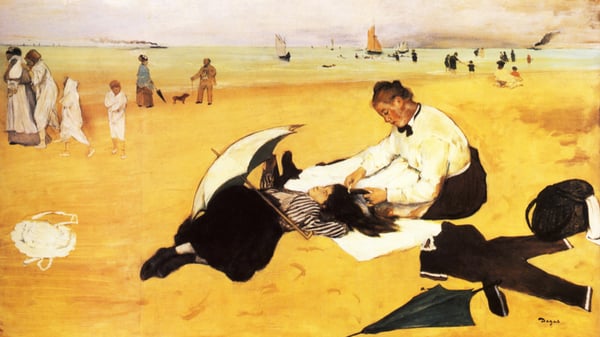
Analisi esperta di Beach Scene di Edgar Degas
Stile: Impressionism · Genere: genre painting
Expert Analysis of "Beach Scene" by Edgar Degas
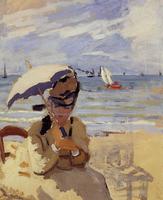
Edgar Degas’s Beach Scene exemplifies the Impressionist fascination with modern leisure while showcasing the artist’s distinct departure from the movement’s typical spontaneous outdoor painting. Although Degas is best known for ballet dancers and horse races, his beach scenes reveal a keen eye for the fleeting, unconventional composition that defines Impressionism.
Composition & Perspective
Degas often eschewed the traditional horizon line and centered subjects. In Beach Scene, he likely positions figures—perhaps bathers or promenaders—at an oblique angle, cropped by the edges of the canvas. This photographic, snapshot-like framing reflects the influence of Japanese prints and the new medium of photography, capturing a spontaneous moment rather than a staged tableau. The viewer is drawn into the scene as if an accidental observer.
Color & Light
True to Impressionist technique, Degas uses broken brushstrokes and a bright, high-key palette. The sand, sea, and sky are rendered in luminous pastels and muted earth tones, with touches of white and blue to convey the glare of sunlight. Unlike Monet’s shimmering water or Renoir’s soft focus, Degas’s application is more linear and structured—shapes are defined by contour, emphasizing the human figure even within the natural setting. This tension between fluid atmosphere and precise draftsmanship is a hallmark of his style.
Thematic Significance
As a genre painting, Beach Scene documents a distinctly modern activity: the leisure of the Parisian middle class at seaside resorts. Degas does not romanticize the landscape; instead, he focuses on the social dynamics—the awkward poses of bathers, the casual grouping of family or friends. This aligns with his broader interest in capturing contemporary life with psychological nuance, often revealing the artificiality of the bourgeois ritual.
Why It Matters
Degas’s beach scenes are significant because they bridge the gap between the spontaneity of Impressionism and the formal rigor of his academic training. Beach Scene demonstrates that Impressionism could be not only about light and air but also about the constructed, often mundane reality of human behavior. It challenges the notion that the movement was purely about “plein air” painting—Degas worked from memory, sketches, and studio compositions, yet still achieved the freshness of a moment caught in time.
In summary, Beach Scene is a masterful example of Degas’s ability to blend genre subject matter with Impressionist innovation, offering a candid, unsentimental view of modern life that continues to resonate with viewers today.
Museum / Gallery
Visivamente simili
20 opere con composizione e palette affini
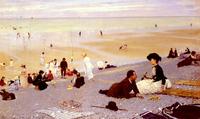
Sur Les Galets
Albert Aublet
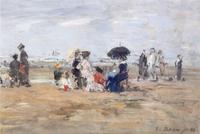
Trouville, scene on the beach
Eugene Boudin
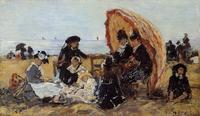
Trouville, on the Beach Sheltered by a Parasol
Eugene Boudin

Beach Scene
Eugene Boudin
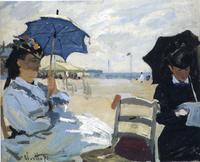
The Beach at Trouville
Claude Monet
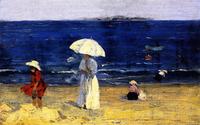
The Beach at Dinard
Clarence Gagnon

Beach at Boulogne
Edouard Manet
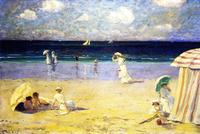
Summer Breeze at Dinard
Clarence Gagnon
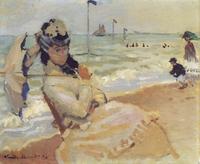
Camille on the Beach at Trouville
Claude Monet

The Beach
Eugene Boudin
Two Works, Ladies on the Beach; Bath Houses Under the Cliffs
Louise Abbéma
Trouville, Beach Scene
Eugene Boudin
A Beach Scene
Eugene Boudin
Hourtide
Edward Henry Potthast
Sketch Figures on Beach (also known as Early Beach)
Maurice Prendergast

Berck, the Beach
Eugene Boudin
On the Beach
Edouard Manet
On the Beach
Edward Henry Potthast
L'heure Du Bain Au Tréport
Albert Aublet
Camille Sitting on the Beach at Trouville
Claude Monet