
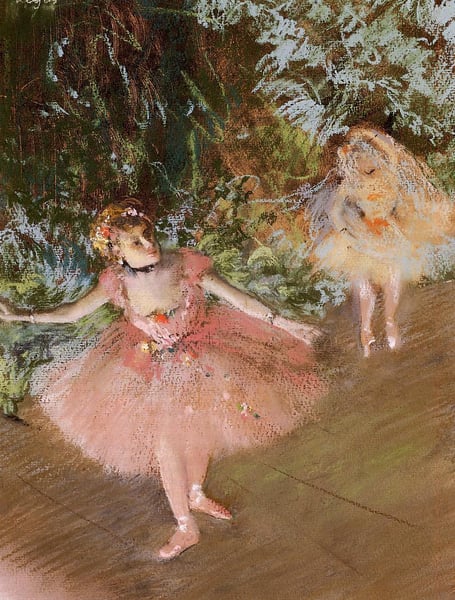
Expert analysis of Edgar Degas’s Dancer on Stage
Style: Impressionism · Genre: genre painting
Expert Analysis: "Dancer on Stage" by Edgar Degas
As a quintessential work of Impressionism, Edgar Degas’s Dancer on Stage exemplifies the movement’s radical shift toward capturing fleeting moments of modern life. Within the genre of genre painting—scenes of everyday existence—Degas elevates a backstage or on-stage ballet rehearsal into a study of movement, light, and psychological tension.
Significance within Impressionism:
While many Impressionists painted landscapes en plein air, Degas focused on indoor, artificial light and the human figure in motion. This painting reflects his fascination with the Parisian ballet, a subject he returned to obsessively. The composition is deliberately asymmetrical and cropped, influenced by photography and Japanese ukiyo-e prints, which were then newly popular in Paris. The dancer is caught mid-gesture, her body slightly off-balance, suggesting a transient pose rather than a static, idealized form. Degas’s use of pastel (or oil, depending on the version) produces a luminous, textured surface; the stage lights create pools of warm oranges and yellows against cooler, atmospheric shadows, emphasizing the artificial environment of the theater.
What Makes It Significant:
- Psychological Depth: Unlike earlier dance paintings, Degas does not idealize his subject. The dancer is anonymous, her face partially obscured or turned away, stripping away narrative in favor of pure visual experience.
- Modernity of Technique: The visible, sketchy brushwork and the unusual vantage point—looking down from the wings—place the viewer as a voyeur, present in the moment of performance. This aligns with Impressionism’s goal of depicting “the impression” of a scene rather than its documentary reality.
- Cultural Context: The ballet was a symbol of Parisian modernity, but Degas reveals its artificiality and labor. The dancer is both a performer and a worker, caught in the glow of footlights, embodying the tension between spectacle and reality.
In Dancer on Stage, Degas synthesizes Impressionist concerns: the play of light, the immediacy of observation, and the poetry of ordinary, transient moments. It stands as a definitive example of how genre painting, in the hands of an Impressionist, could capture the pulse of modern life.
Museum / Gallery
Visually similar
20 works with related composition and palette

Dancers on Set
Edgar Degas

Two Dancers Entering the Stage
Edgar Degas

Dancer on Stage with a Bouquet
Edgar Degas
Dancers
Edgar Degas

Three Ballet Dancers
Edgar Degas
Two Dancers on Stage
Edgar Degas

Dancer
Edgar Degas

Ballet Scene
Edgar Degas

The Green Dancer
Edgar Degas
On Stage
Edgar Degas

Two Dancers in the Foyer
Edgar Degas
The Star
Edgar Degas

The Star - Dancer on Pointe
Edgar Degas
Dancer with a Bouquet Bowing
Edgar Degas
The Step with Battement
Edgar Degas

Dancer with Raised Arms
Edgar Degas

Les Pointes
Edgar Degas
Four Ballerinas on Stage
Edgar Degas

Two Dancers on a Bench
Edgar Degas

Dancer with a bouquet of flowers (The Star of the ballet)
Edgar Degas