Expertenanalyse zu Edgar Degass Edmond and Thérèse Morbilli
Stil: Impressionism · Genre: portrait
Expert Analysis: "Edmond and Thérèse Morbilli" by Edgar Degas
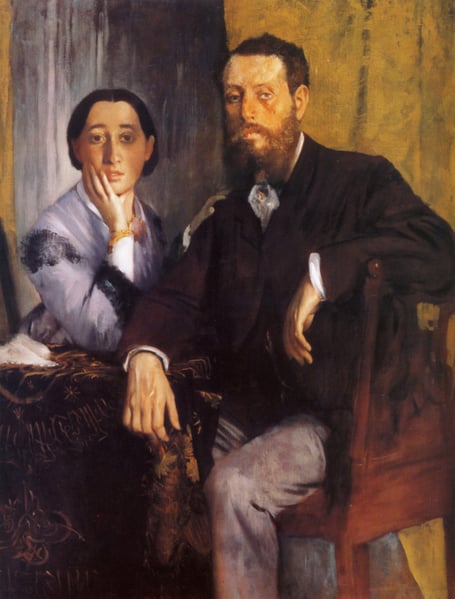
Edgar Degas’s Edmond and Thérèse Morbilli (c. 1867) stands as a pivotal early example of the artist’s transition from academic history painting to the radical innovations of Impressionism. Though often celebrated as a painter of dancers and modern life, Degas was an incisive portraitist, and this work—depicting his sister Thérèse and her husband, the Italian nobleman Edmond Morbilli—reveals the psychological complexity and compositional daring that would define his mature style.
Significance within Impressionism and Portraiture
Degas’s approach to this double portrait breaks with traditional conventions. Rather than presenting the couple in a formal, idealized pose, he captures a moment of quiet tension and unspoken distance. Thérèse sits rigidly, her hands folded, gaze slightly averted, while Edmond stands behind her, his posture stiff and his expression guarded. The subtle asymmetry—his upright figure versus her seated, almost compressed form—creates a visual disharmony that mirrors the known strains in their marriage. This psychological penetration is a hallmark of Degas’s portraits, elevating the work beyond mere likeness into a narrative of human relationship.
The composition also demonstrates Degas’s early experimentation with unconventional framing and cropping, likely influenced by photography and Japanese woodblock prints. The cutting of Edmond’s figure at the edge of the canvas and the off-center placement of Thérèse foreshadow the snapshot-like immediacy of later Impressionist works. Yet the palette remains restrained—deep blacks, muted grays, and earthy tones—recalling the influence of his academic training under Ingres and his study of Old Masters.
Context and Legacy
Painted during Degas’s formative years, this portrait is a key document of his family ties and his move away from historical subjects. It was exhibited at the Salon of 1869, where its quiet realism and modern sensibility were noted. Crucially, it demonstrates that Degas, though associated with Impressionism, never fully abandoned structure and line—his portraits are as much about psychological space as they are about light and color. Edmond and Thérèse Morbilli thus occupies a vital place in Degas’s oeuvre: a bridge between tradition and the avant-garde, and a masterful study of the intimacy and alienation that define modern life.
Museum / Gallery
Visuell ähnlich
20 Werke mit ähnlicher Komposition und Farbpalette
Portrait of Monsieur and Madame Auguste Manet
Edouard Manet
The Artist`s Parents
Felix Vallotton
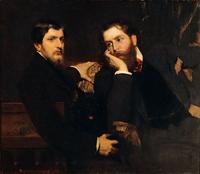
Portrait de Ses Deux Fils (André et Emmanuel)
Benjamin Constant
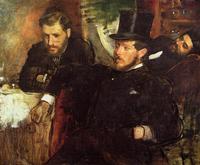
Jeantaud, Linet and Laine
Edgar Degas
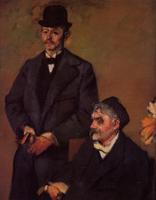
Henri Rouart and His Son Alexis
Edgar Degas
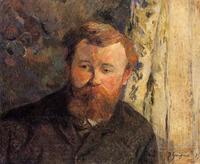
Portrait of Achille Granchi Taylor
Paul Gauguin
Portrait of Zacharie Astruc
Edouard Manet
The sculptor Reinhold Begas with his wife Margarethe
Anton Romako
A gentleman and his two sons
John Alfred Mohlte
Mr. and Mrs. John W. Field
John Singer Sargent
Ambroise Vollard
Pierre-Auguste Renoir

Die Eltern Des Künstlers
Johann Victor Kramer
Portrait of the artist Albert Benois
Nikolai Kuznetsov
Antonin Proust
Anders Zorn
Self-Portrait
Richard Caton Woodville Sr.
Portrait of a Man
Edgar Degas
Self-Portrait at the Easel
Lovis Corinth
Self Portrait
John Singer Sargent
Alfred Sisley
Pierre-Auguste Renoir
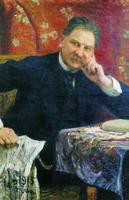
Portrait of J.M. Vengerov
Ilya Repin