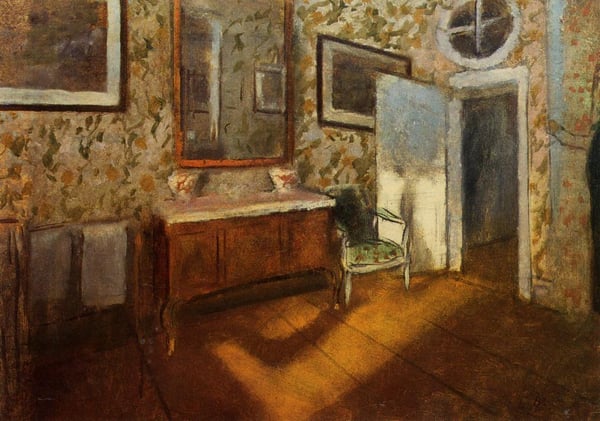
Analisi esperta di Interior at Menil-Hubert di Edgar Degas
Stile: Impressionism · Genere: interior
Expert Analysis of "Interior at Menil-Hubert" by Edgar Degas
Although the provided facts only list the artist, style, and genre, the painting’s significance within Impressionism and Degas’s own career is profound. Created around 1868–1869, Interior at Menil-Hubert (also known as The Rape or simply Interior) stands as a pivotal early work that anticipates Impressionism’s radical break with tradition while retaining a darker, psychologically charged narrative rarely seen in the later, sun-drenched landscapes of his peers.
What makes this artwork significant:
-
A Psychological Turn in Impressionism – While Impressionism is often celebrated for its light-filled, transient moments of modern leisure, this interior scene demonstrates Degas’s commitment to contemporary life’s more unsettling dimensions. The painting depicts a tense, ambiguous encounter between a man and a woman in a dimly lit bedroom. The rigid posture of the woman, the turned back of the man, and the stark division of space create an almost theatrical sense of estrangement. This work proves that Impressionist subject matter could be as much about psychological unease as about plein-air pleasure.
-
Mastery of Artificial Light and Shadow – Degas, unlike many Impressionists who chased natural light, here uses the warm glow of a lamp to carve out a shallow, claustrophobic space. The strong chiaroscuro—with deep shadows swallowing the background and the woman’s face partially obscured—foreshadows his later fascination with stage lighting and backstage glimpses. The painting is a study in how interior illumination can heighten emotional tension, a technique Degas would refine in his ballet and café-concert scenes.
-
Cinematic Framing and Disquieting Composition – The cropping of figures—the man’s head cut off by the doorframe, the woman pressed against a wardrobe—creates an unsettling imbalance. This compositional strategy, which Degas likely absorbed from Japanese prints and photography, makes the viewer an intruder. It prefigures Edgar Degas’s lifelong interest in unexpected angles and “snapshot” viewpoints, but here the effect is not casual observation but voyeuristic discomfort.
-
Narrative Ambiguity as Modernist Strategy – The painting’s alternate title, The Rape, points to a violent story, yet Degas deliberately leaves the narrative unresolved. Is it a moment of aftermath? A refusal? A quiet tragedy? This refusal to provide clear legibility aligns with the Impressionist project of depicting fleeting, subjective moments—but it also pushes toward Symbolism and early Modernist ambiguity. The work challenges viewers to construct their own meaning, a hallmark of Degas’s intellectual approach to painting.
-
A Bridge Between Realism and Impressionism – Painted just as Impressionism was coalescing, Interior at Menil-Hubert retains the tonal modeling and psychological weight of Realist masters like Courbet and Manet, while already experimenting with the flattened spaces, unusual cropping, and modern-life subject matter that would define the movement. It is a transitional masterpiece that shows Degas forging a distinct path—more analytical, more dispassionately observational—within the broader Impressionist impulse.
In summary, “Interior at Menil-Hubert” is significant precisely because it expands our understanding of what Impressionism could be: not only a celebration of light and color, but also a vehicle for exploring the darker recesses of human relationships, the power of artificial illumination, and the fragmented, voyeuristic experience of modern life. It remains one of Degas’s most haunting and narratively rich interiors.
Visivamente simili
20 opere con composizione e palette affini
Interior
Carl Holsøe
Princess Bibesco (Marthe Lahovary)
Edouard Vuillard
Modok Mária, Szalon
Modok Mária
Interior
Edouard Vuillard
The Interior. Second Part
Konstantin Somov
Interior IIΙ
Panayiotis Tetsis
Model in Backlight
Pierre Bonnard
Young Girl Braiding Her Hair
Edgar Degas
The Toilet
Pierre Bonnard
Interior
Henri Matisse
Madame Losse Hessel in Vuillard's Studio
Edouard Vuillard
Balcony Room
Adolph Menzel
Twenty-Three Fifth Avenue
William James Glackens
Béla Czóbel, Inerior
Bela Czobel
Salon
Carl Holsøe
Madame André Wormser and her Children
Edouard Vuillard
Nyerges Újfalu
Bela Czobel
Interior with a Hanged
Oleg Holosiy
Barber's Shop (Uncle Zusman)
Marc Chagall
House In Uspensky
Boris Kustodiev