Expert Analysis: "Racehorses before the Stands" by Edgar Degas
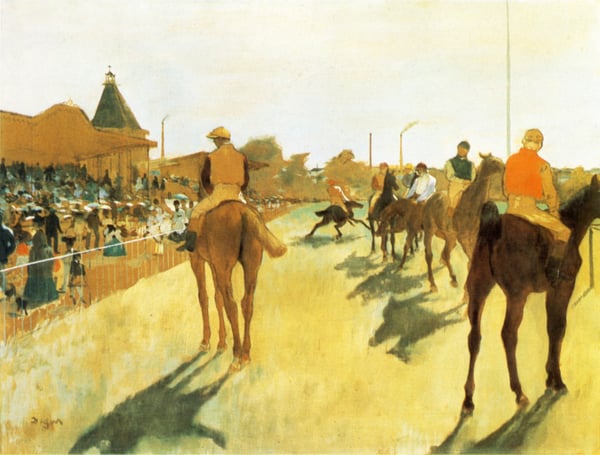
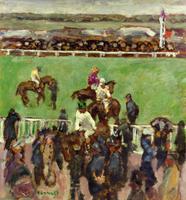
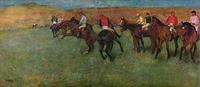
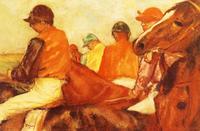
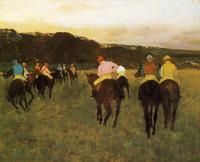
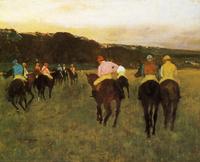
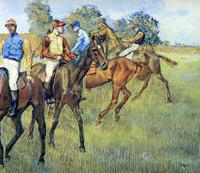
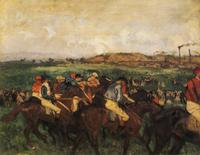
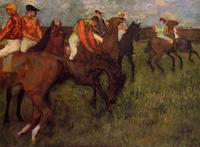
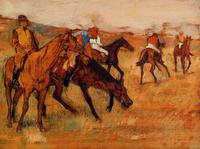
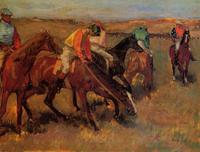
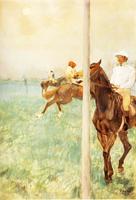
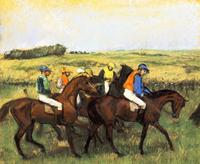
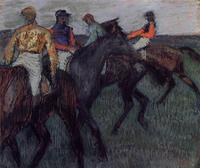
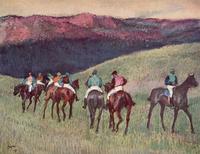
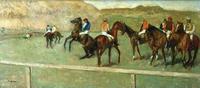
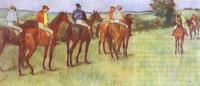
As an Impressionist genre painting, Edgar Degas’s “Racehorses before the Stands” captures a quintessentially modern leisure scene of 19th-century Paris—the racetrack. Degas, though often grouped with the Impressionists, stands apart for his rigorous draftsmanship and fascination with movement, especially of horses and dancers. In this work, significance lies in its radical compositional approach: he crops the horses and stands asymmetrically, borrowing from photography and Japanese prints, to evoke a candid, momentary glimpse rather than a staged tableau. The brushwork is lively but controlled, with dappled light and subtle color harmonies that convey the atmosphere of a brisk afternoon at the races. Unlike earlier narrative genre scenes, Degas presents no story—just the pure, kinetic energy of horses being led to the start, the crowd a blur of hats and parasols. This focus on a fleeting instant, observed from an unexpected angle, epitomizes Impressionism’s break from academic tradition and its embrace of contemporary life as it is lived.