Expertenanalyse zu Edgar Degass Riders on a Road
Stil: Impressionism · Genre: genre painting
Expert Art Historical Analysis: "Riders on a Road" by Edgar Degas
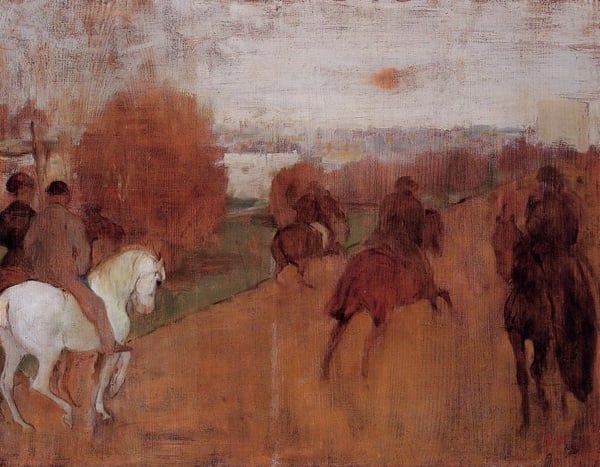
Edgar Degas’ "Riders on a Road" (c. 1870s–1880s) exemplifies the artist’s distinctive contribution to Impressionism while operating firmly within the tradition of genre painting—the depiction of everyday life. Though Degas is often celebrated for his ballet dancers and café scenes, his equestrian subjects reveal a parallel fascination with modern leisure and the fleeting rhythms of movement.
Significance within Impressionism:
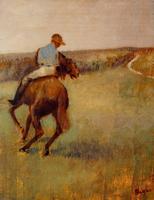
Unlike many of his peers who focused on open-air, dappled light and landscape, Degas brought a compositional audacity to Impressionist practice. In "Riders on a Road," he adopts a high vantage point and a radical cropping of the figures—horses and riders are sliced by the picture’s edges, suggesting a snapshot caught in motion. This borrows from photography and Japanese ukiyo-e prints, which Degas avidly collected. The result is a scene that feels spontaneous yet meticulously arranged. The road recedes diagonally, pulling the eye backward, while the riders’ bodies are rendered with swift, economical strokes that capture the instantaneous quality of an afternoon ride.
Genre painting reimagined:
As a genre painting, "Riders on a Road" does not merely document a leisurely activity; it transforms it into a study of tension between control and fluidity. The horses’ muscles, the riders’ upright postures, and the dust on the path are all suggested through layered pastel or oil—the medium is not specified, but Degas often used pastel for its dry, velvety texture, allowing him to build up translucent layers of color. The palette is subdued: taupes, ochres, and soft blues, typical of his palette in the 1870s, emphasizing atmosphere over narrative.
Why it matters:
This work sits at the intersection of Degas’s lifelong interests: the human figure in motion, the geometry of space, and the ephemeral effects of light. Unlike his more famous racecourse scenes, "Riders on a Road" strips away the spectacle of the track, focusing instead on the quiet, almost anonymous act of travel. It is a precursor to his later, more radical experiments with skewed perspectives and fragmented compositions—hallmarks that would influence modernists from Seurat to Hopper.
In short, "Riders on a Road" is significant as a synthesis of Impressionist spontaneity and Degas’s classical discipline, proving that genre painting could be both a record of modern life and a formal laboratory for innovation.
Museum / Gallery
Visuell ähnlich
20 Werke mit ähnlicher Komposition und Farbpalette
The Promenade on Houseback
Edgar Degas
The Riders
Edgar Degas
Two Knights in Armor
Henri de Toulouse-Lautrec
Riders on the Beach I
Paul Gauguin
The Trainers
Edgar Degas
Man and Woman Riding through the Woods
Henri de Toulouse-Lautrec
Ride. Boris and Yu. Kustodiyevs
Boris Kustodiev
Horsewoman and Dog
Henri de Toulouse-Lautrec
Childe Harold's Pilgrimage
Albert Pinkham Ryder
Observation Fabre, Reserve Officer
Henri de Toulouse-Lautrec
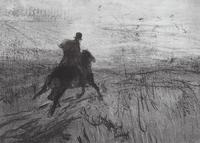
Pushkin in the village
Valentin Serov
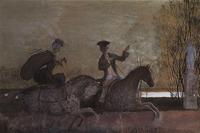
Evening Rides
Konstantin Somov
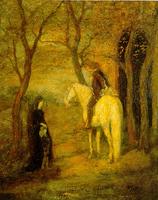
Roadside Meeting
Albert Pinkham Ryder
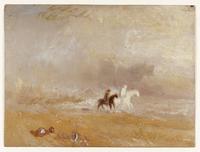
Riders on a Beach
J.M.W. Turner
Jockeys
Edgar Degas
At the Races
Henri de Toulouse-Lautrec
Horses and Jockeys
Edgar Degas
The Last Autumn Race
Stefan Luchian
Jockey in Blue on a Chestnut Horse
Edgar Degas
Berény Róbert , Jelenet
Berény Róbert