Edgar Degas sanatçısının Studio Interior with 'The Steeplechase' eseri hakkında uzman analizi
Tarz: Impressionism · Tür: interior
Expert Analysis: "Studio Interior with 'The Steeplechase'" by Edgar Degas
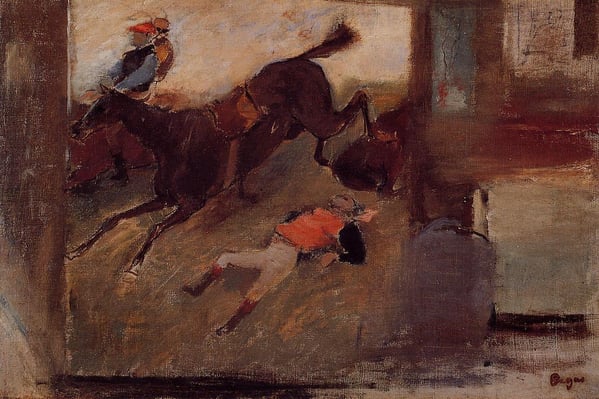
Edgar Degas’s Studio Interior with 'The Steeplechase' is a compelling example of how Impressionism—a movement often associated with landscapes and outdoor leisure—could be turned inward to explore the very process of making art. Painted in an interior genre, the work offers a rare, self-reflexive glimpse into the artist’s working space, foregrounding the relationship between the act of creation and the world it represents.
Significance within Impressionism:
While many Impressionists sought to capture fleeting moments of modern life in public settings, Degas frequently turned his gaze to private, domestic, and professional interiors. Here, the composition is built around a mise en abyme: the painting within the painting. At the center hangs The Steeplechase (a Degas work from the same period), a dynamic scene of horse racing—an outdoor, action-filled subject typical of Impressionist themes. By placing this canvas inside a quiet, cluttered studio, Degas creates a deliberate tension between the spontaneous energy of the painted steeplechase and the controlled, reflective space of the studio. This juxtaposition underscores Impressionism’s fascination with capturing motion and immediacy, while also acknowledging the stillness and labor required to produce such an image.
Stylistic Innovations:
Degas’s treatment of the interior is characteristically unconventional. The viewpoint is slightly elevated and askew, as if the viewer has entered the studio unannounced. The framing is cropped and asymmetrical—a hallmark of Degas’s debt to photography and Japanese prints—drawing attention to the edges of the room and the margins of the easel. Light filters in from an unseen window, casting soft shadows that model the furniture and the canvas, but the overall palette is muted, emphasizing browns, ochres, and deep greens. This restraint allows the brightly colored steeplechase scene within to pop, creating a visual dialogue between finished art and its raw surroundings.
The Interior as Modern Subject:
Degas elevates the studio—a space traditionally considered preparatory or private—to a valid subject of modern art. By including the partially visible tools of his trade (perhaps a chair, a stool, a palette), he demystifies the artistic process. The interior becomes a psychological space: a quiet counterpoint to the violent motion of the horse race. This reflects a deeper concern within Impressionism: the tension between observation and construction, between the world as it is and the world as it is rendered on canvas.
Conclusion:
Studio Interior with 'The Steeplechase' is significant precisely because it is not a typical Impressionist scene. It represents Degas’s intellectual rigor—his insistence on examining the conditions of vision and representation. In this interior, he reminds us that even the most fleeting, outdoor Impressionist image is born from a studio ceiling, a table, and the patient eye of the artist. It is a meta-painting that enriches our understanding of Impressionism as both a sensory and a conceptual movement.
Museum / Gallery
Görsel olarak benzer
İlişkili kompozisyon ve renk paletine sahip 20 eser
Scene from the Steeplechase - the Fallen Jockey
Edgar Degas
Jockeys
Edgar Degas
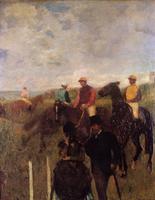
At the Races
Edgar Degas
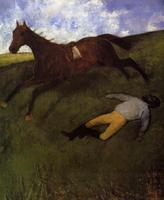
The Fallen Jockey
Edgar Degas
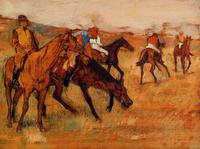
Before the Race
Edgar Degas
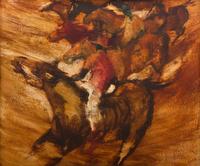
Horseman
Jacqueline Hick
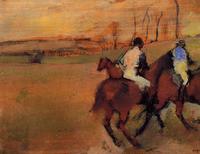
Horses and Jockeys
Edgar Degas
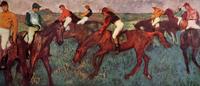
Jokeys Training
Edgar Degas
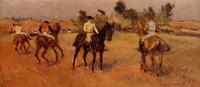
Four Jockeys
Edgar Degas
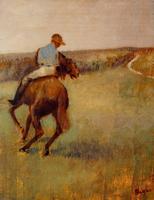
Jockey in Blue on a Chestnut Horse
Edgar Degas
Gentlemen Jockeys before the Start
Edgar Degas
The Racecourse, Amateur Jockeys
Edgar Degas
Before the Race
Edgar Degas
Three Jockeys
Edgar Degas
Courses a Saint Cloud
Emilio Grau Sala
Jockeys
Edgar Degas
Before the Race
Edgar Degas
At the Races - Before the Start
Edgar Degas
At the races
Edouard Manet
Jockeys before the Start with Flagpoll
Edgar Degas