Expertenanalyse zu Edgar Degass Tuileries, the woman with a parasol
Stil: Impressionism · Genre: portrait
Expert Analysis: "Tuileries, the woman with a parasol" by Edgar Degas
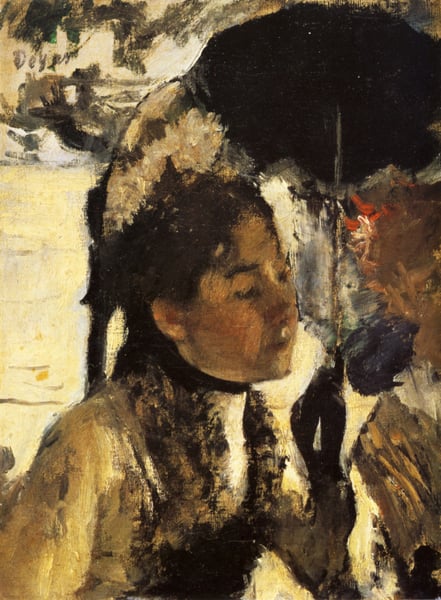
This intimate portrait exemplifies Degas’s distinctive contribution to Impressionism, a movement that sought to capture the ephemeral moments of modern life with a fresh, unposed immediacy. While many Impressionists focused on landscapes or urban scenes, Degas often turned his gaze to the human figure in candid settings—here, a woman shaded by a parasol in the Tuileries Garden.
Significance within Impressionism and Degas’s Oeuvre:
-
Modern Life as Subject: The Tuileries Garden was a quintessential gathering place for Parisian society—a stage for leisure, fashion, and fleeting encounters. By painting a woman with a parasol, Degas elevates a casual, everyday moment into art, reflecting the Impressionist commitment to depicting contemporary life rather than historical or mythological scenes.
-
Unconventional Framing and Cropping: Degas was deeply influenced by photography and Japanese ukiyo-e prints, which often featured asymmetrical compositions and cut-off forms. In this work, the figure is likely set slightly off-center, with the parasol perhaps partially framing the face or casting a shadow that breaks up form. This creates a sense of spontaneity, as though the viewer is glimpsing a private instant.
-
Color and Light: The parasol serves not only as a sun-shade but as a tool for modulating light. Degas would have rendered the dappled sunlight filtering through foliage, with the parasol casting a soft, colored shadow on the woman’s face and dress. This interplay of warm and cool tones—perhaps pale violets, blues, and pinks—embodies the Impressionist fascination with atmospheric effects.
-
Psychological Depth: Unlike many impressionist portraits that emphasize outward appearance, Degas often imbued his subjects with a sense of introspection. The woman’s pose—perhaps slightly aloof or lost in thought—hints at the inner life of a modern Parisian, making this work a bridge between pure impression and psychological portraiture.
Conclusion:
"Tuileries, the woman with a parasol" is significant for how it encapsulates Degas’s unique synthesis of Impressionist plein-air spontaneity with his own rigorous draftsmanship and interest in human gesture. It stands as a masterful example of the portrait genre within Impressionism—not just a record of a face, but a fleeting slice of social history, captured in light, color, and poised ambiguity.
Museum / Gallery
Visuell ähnlich
20 Werke mit ähnlicher Komposition und Farbpalette
At the Races
Edgar Degas
Le Place Clichy
Pierre-Auguste Renoir
Anne Estelle Rice in Paris (Closerie des lilas)
John Duncan Fergusson
The Umbrella
Pierre-Auguste Renoir
The Cafe
Pierre-Auguste Renoir
At the Café
Edgar Degas
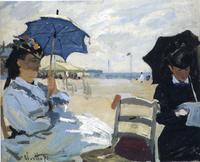
The Beach at Trouville
Claude Monet

Portrait of Alaide Banti
Giuseppe De Nittis
Two Girls in Black
Pierre-Auguste Renoir

Umbrellas
Pierre-Auguste Renoir
At the Milliner`s
Pierre-Auguste Renoir
Young Woman and Child on an Isle
Berthe Morisot
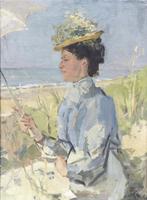
At the Beach - Portrait of Martha Salomon
Isaac Israels
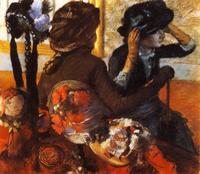
At the Milliner's
Edgar Degas
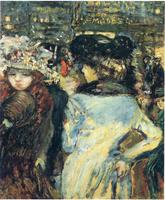
Two Elegant Ladies, Place de Clichy
Pierre Bonnard
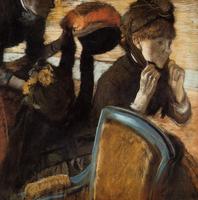
At the Milliner's
Edgar Degas
Ksenija Atanasijević
Nadezda Petrovic
Portrait Of Mrs. D. Calisch-Hijmans Kröller-Müller
Isaac Israels
Young Woman and Child, Avenue du Bois
Berthe Morisot
Young Woman Sewing in the Garden
Mary Cassatt