Expert analysis of Henri Matisse’s Garden at Issy
Style: Cubism · Genre: landscape
Expert Art Historical Analysis: Garden at Issy by Henri Matisse
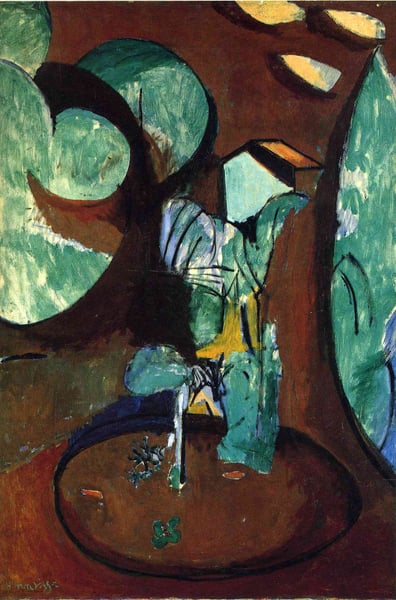
Despite Henri Matisse’s reputation as a leading Fauvist, Garden at Issy represents his significant, though often overlooked, engagement with Cubism. Executed as a landscape, the painting is a crucial document of the brief moment when Matisse incorporated Cubist spatial logic into his own vibrant palette, producing a work that bridges two revolutionary movements.
Significance within Cubism and Matisse’s Oeuvre
-
Cubist Structure Meets Fauve Color
The painting demonstrates Matisse’s adaptation of the analytic Cubist vocabulary—faceted planes, fragmented forms, and a shallow, tilting picture plane—but infuses it with the intense, non-naturalistic hues characteristic of his Fauve period. This synthesis distinguishes Garden at Issy from the more muted, monochromatic palettes of contemporary Cubists like Picasso or Braque. The result is a landscape that feels both structurally rigorous and emotionally vibrant, expanding Cubism’s expressive range. -
The Subject as a Personal Laboratory
Issy-les-Moulineaux was the site of Matisse’s suburban home and garden, a place he often used as a testing ground for new ideas. Here, the artist applies Cubist deconstruction to a familiar, intimate motif—trees, paths, foliage, and architectural elements—rather than studio still lifes or figures. By breaking down a personal landscape into intersecting geometric planes, Matisse asserts that Cubism could handle the organic, daylight world, not just artificial or still compositions. -
A Dialog with Picasso and the Cubist Circle
Painted during the height of Cubism’s development (circa 1911–1912), Garden at Issy demonstrates Matisse’s willingness to absorb and challenge his rival Picasso’s innovations. While Picasso’s Cubist landscapes (e.g., Houses at L’Estaque) often suppress color and rely on monochrome to emphasize structure, Matisse retains a decorative, chromatic energy. This tension between order and sensuality makes the painting a key example of the “coloristic Cubism” that set Matisse apart and influenced later artists who sought to reconcile form with feeling. -
Transitional Masterpiece
Historically, Garden at Issy stands as a transitional work that connects Matisse’s early Fauvist experiments with his later, more decorative and simplified styles (such as the cut-outs). It shows that Matisse did not simply reject Cubism but rather used it to refresh his own approach to pictorial space—a fact that underscores his versatility and the dynamic cross-currents of early 20th-century modernism.
Conclusion
Garden at Issy is significant because it proves Cubism was not a monolithic style but a flexible language that could be adapted to different artistic temperaments. In Matisse’s hands, Cubist fragmentation becomes a tool for amplifying, rather than suppressing, the pleasure and immediacy of the natural world. The painting remains a rare and telling instance of a colorist mastering the Cubist grid, making it a pivotal work in both Matisse’s career and the broader narrative of modern art.
Museum / Gallery
Visually similar
20 works with related composition and palette
Improvisation 4
Wassily Kandinsky
Improvisation 7
Wassily Kandinsky
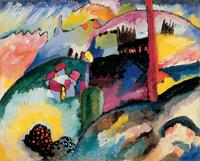
Landscape with factory chimney
Wassily Kandinsky
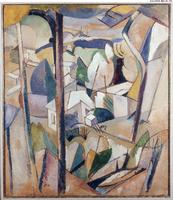
Untitled
Albert Gleizes
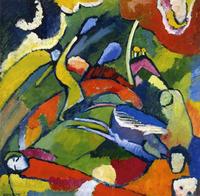
Two riders and reclining figure
Wassily Kandinsky
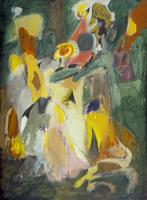
Waterfall
Arshile Gorky

Tiefer Mond
Max Gubler

Lanscape II
Karlo Zvirynsky

4.099
Fons Heijnsbroek

Woman with umbrella. The Parisian
Robert Delaunay

Landscape, near Nice
Graham Sutherland

Small Composition III
Franz Marc
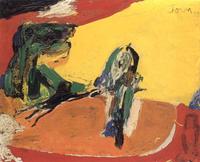
Le Soldat et son passé
Asger Jorn

Abstract Composition
Oleksandr Bogomazov

Composition IV
Wassily Kandinsky
Autumn
Gene Davis
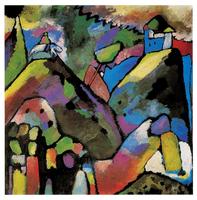
Improvisation 9
Wassily Kandinsky

The Storm
August Macke

Composition
Avigdor Arikha
Imaginary Cityscape
George Stefanescu